Beat analysis isn't about labeling every moment with an emotion. It's about identifying where your character changes — what they want in this moment, how they're trying to get it, and when that changes. Those three things — beats, tactics, and temperature shifts — give you a working map of any scene. This article shows you how to mark all three, using a method you can apply to any text before your next rehearsal.
What to Mark and Why: Beats, Tactics, and Temperature Shifts
Three distinct layers go into a usable beat analysis. Each one answers a different question about what's happening in the scene.
Beats — What does my character want right now?
A beat is a unit of intention. It begins when your character wants something specific and ends when that intention changes — because they got it, failed, gave up, or were interrupted. A beat isn't a line. A single line can hold multiple beats, or one beat can stretch across a full page.
You don't mark beats by feeling. You mark them by asking: "What does my character want right now? Is it the same thing they wanted in the line before?" When the answer changes, you've found a beat shift. There's no correct number for a scene — what matters is that each mark represents a genuine shift in intention, not just a topic change.
Tactics — How is my character trying to get it?
Within a beat, your character doesn't stay passive. They try something. If it doesn't work, they try something else. A tactic is the specific method used to get what the beat is after — demanding, deflecting, charming, withdrawing, exposing.
Tactics are verbs: to manipulate, to challenge, to comfort, to confess. When you mark a tactic, you're naming the action, not the emotion. Two actors can play the same beat with different tactics and both be right. Marking the tactic makes your choice explicit and repeatable — something concrete to bring into the room and change if the director asks you to.
Temperature shifts — How has the energy state changed?
Temperature isn't volume. It's the underlying energy: how open, how guarded, how urgent, how resigned. A temperature shift is different from a new tactic — it's a change in the ground beneath everything else. Sometimes it happens on a single word. Mark it with a circle or a bracket where the shift occurs.
Together, these three layers give you a scene that's workable rather than theoretical. You know where you're going, how you're trying to get there, and where the floor changes. For the broader context around breaking down text, characters, and scene logic, see the full Script Analysis & Character Breakdown hub.
How to Mark a Scene: A Step-by-Step Method With an Example
Work through these steps in order. Don't try to mark all three layers at once on the first pass.
- Read the scene once without marking. Understand what happens start to finish. Resist annotating.
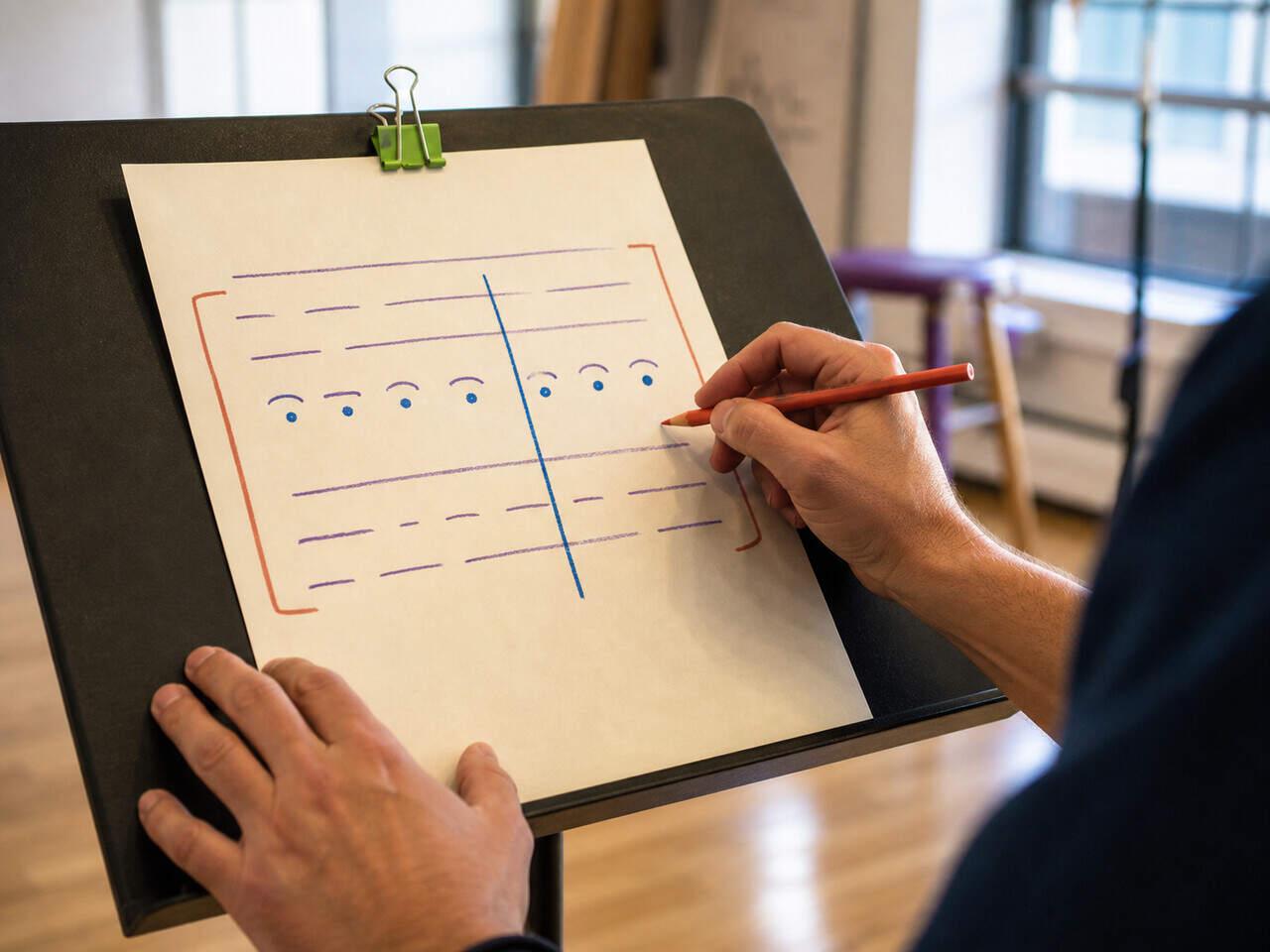
- Identify the major beats. Go line by line and ask: "Is this the same intention as the line before?" Where it changes, draw a vertical line ( / ) in the margin. Every section between two lines is one beat.
- Name each beat. In the margin beside each beat, write a short phrase that captures the character's intent: "forcing a choice," "avoiding the subject," "testing loyalty." Be specific — not "tense" but "demanding a straight answer."
- Mark the tactics within each beat. Under the beat name, write the action verb: to pressure, to stall, to reassure. If the tactic shifts mid-beat, note the new verb where it changes.
- Circle temperature shifts. Go back through and identify the moments where the underlying energy changes — not just a new move, but a new state. Circle the word or line where it lands.
Example: original scene
A: I thought you'd already left. (beat: buying time / tactic: to deflect) B: I'm still here. You knew that. (beat: holding ground / tactic: to expose) A: Right. I just — I wasn't sure you'd want to talk. (tactic shifts: to retreat, to test) B: I always want to talk. That's not the issue. (temperature shift: resignation under the claim) A: Then what is the issue? (new beat: forcing the question / tactic: to confront)
In this exchange, A has two beat shifts and a tactic change. B has a temperature shift that changes everything about how A's last line reads. Without marking that shift, you'd play the scene as if both characters are frustrated. With it, you understand that B has already given up on something — and A hasn't figured that out yet.
Keep your beat map, tactic verbs, and temperature markers attached to the scene itself — in the margin of the script you actually rehearse from, not in a separate notebook you'll leave at home. A beat analysis you can't see while you work is one you'll quietly abandon by the second rehearsal.
One failure mode to watch: over-marking. If you draw a beat shift every two lines, you haven't found the structure — you've just annotated the punctuation. A scene with twenty beats is usually a scene you haven't made decisions about yet. Force yourself to name the three or four shifts that genuinely change what your character is doing, and leave the rest unmarked. The map is useful precisely because it's selective. When the director gives you an adjustment, you change one tactic verb on one beat — not your sense of the whole scene.
Do it in HitCue
- Scene notes: attach your beat marks, tactic notes, and temperature observations directly to the scene — so they're there every time you open it to rehearse or review.
- Character focus view: isolate your character's lines to track how their intentions and tactics shift across the full scene without the surrounding dialogue getting in the way.
- Scene navigation: jump directly to the scene you're analyzing without scrolling through the whole script.
Import your script and start marking beats in context. → Download HitCue