HitCue for theatre actors
Learn theatre lines alone. Arrive ready to rehearse.
Upload a PDF, Word, or text script. HitCue organizes the scenes, gives you the other cues, and helps you test your memory.
Free to download on iOS and Android.


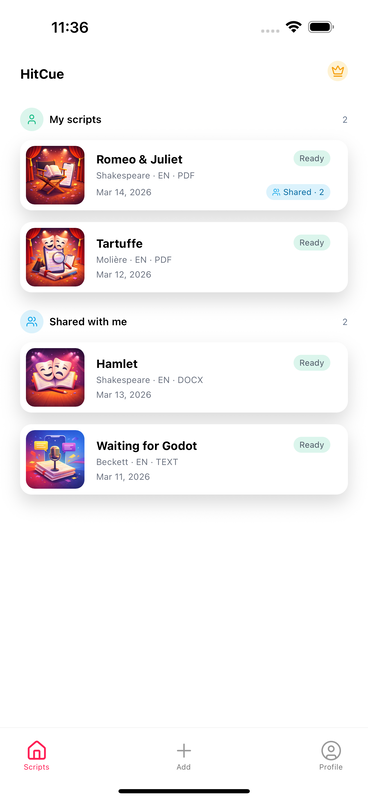
From file to rehearsal
Keep the work on the scene, not scattered across tools.
- 01
Upload your script
Import a PDF, Word, or text file and turn it into acts, scenes, characters, and dialogue you can navigate.
- 02
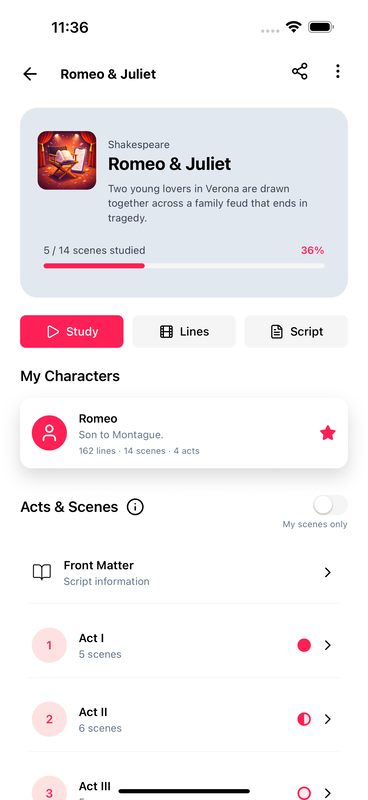
Choose your character
Keep your scenes, lines, cues, notes, and character work in view instead of searching through every page.
- 03
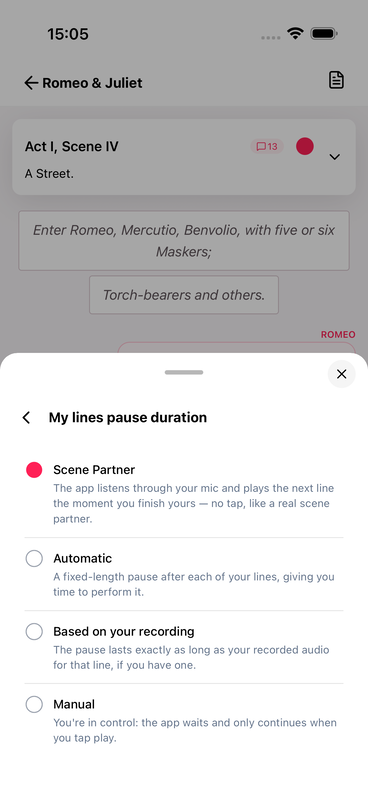
Rehearse with Scene Partner
Hear the other role, say your line out loud, and let HitCue continue as soon as you finish.
Features
Rehearse every cue out loud
Hear the other role, say your own lines, and move from supported reading to a real memory check.
Scene Partner listens and continues
HitCue follows your words through the microphone and plays the next cue as soon as you finish.
Blackout mode at your level
Hide a line fully, leave its first word or initials visible, and reveal it only when you need a prompt.
Hear the other role
Use synthetic voices or human dialogue recordings, then answer out loud when your cue arrives.
Keep a changing script ready to work
Turn a flat file into a rehearsal workspace you can navigate, annotate, correct, and update as the production moves.
Find the work fast
Move through acts, scenes, dialogue, or the full script. Filter to only your scenes and see line counts before you begin.
Build character work beside the text
Keep character details, relationships, objectives, emotional arc, and private notes where you prepare the scene.
Correct and update the text
Edit lines, resolve character aliases, and choose the right update mode when a new version of the script arrives.
Keep cast material attached to the scene
With HitCue Pro, rehearsal can continue outside the room without splitting notes and recordings across group chats.
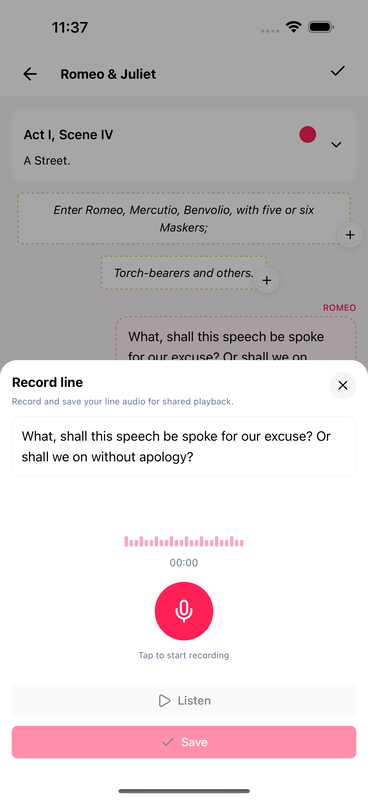
Cast recordings for solo practice
Record and share human dialogue in scene context, so castmates can run the scene between rehearsals.
Shared notes in context
Keep rehearsal directions and decisions on the scene where the cast will need them again.
One script link for the cast
Invite cast members with a link and manage who still has access to the script.
Pricing
Start free with script study, character focus, Blackout mode, recordings, and the theatre calendar. Pro adds Scene Partner, offline study, deeper drill controls, and cast collaboration.
Start studying scripts and scenes on your own.
Included
- 1 active script
- 3 script uploads per month
- 1 personal character
- Standard AI script analysis
- Scene navigation and character focus
- Blackout mode and reveal hidden lines
- TTS playback and dialogue recordings
- 2 dialogue styles
- Theatre calendar, recurring events, and reminders
Unlock full study flow and collaboration for active rehearsals.
Everything in Free, plus
- Scene Partner listens and continues
- Unlimited active scripts
- 6 script uploads per month
- Unlimited personal characters
- Advanced AI script analysis
- Offline study access
- Shared notes
- Share and listen to cast recordings
- Scene-by-scene progress tracking
- 4 dialogue styles
- Loop and auto-advance scenes
- Personal line annotations (highlight, notes, markers, emotions)
All Pro features with annual billing for long-run productions.
Everything in Free, plus
- Scene Partner listens and continues
- Unlimited active scripts
- 6 script uploads per month
- Unlimited personal characters
- Advanced AI script analysis
- Offline study access
- Shared notes
- Share and listen to cast recordings
- Scene-by-scene progress tracking
- 4 dialogue styles
- Loop and auto-advance scenes
- Personal line annotations (highlight, notes, markers, emotions)
FAQ'S
Frequently Asked Questions
Need help? Email us at support@hitcue.app.
Latest from the blog
New rehearsal guides for your next run

Annotation
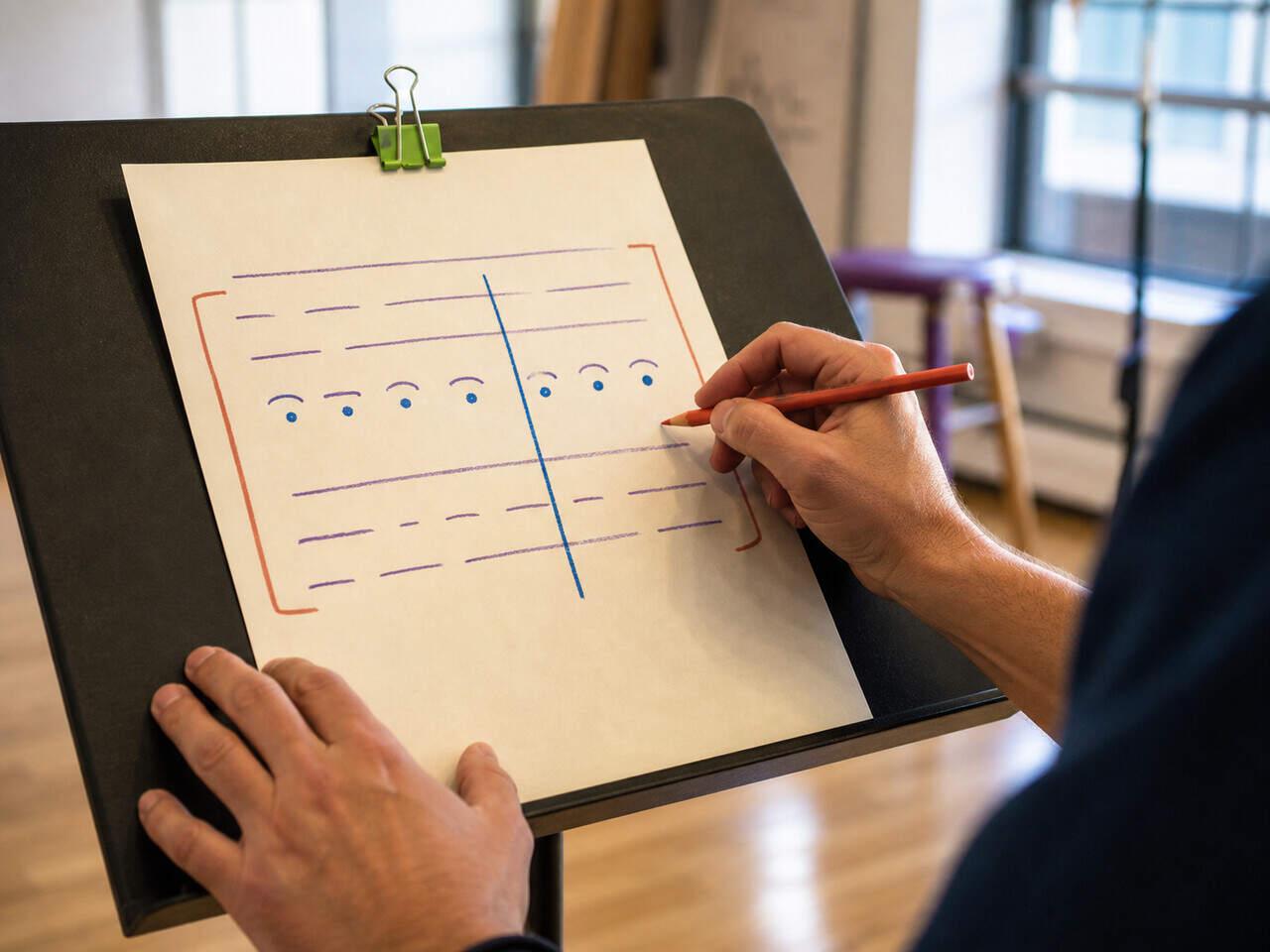
Blocking in Theatre: How Actors Should Record and Update It
Blocking is not a note you write once. It's a record you rewrite several times before opening, so the way you write it matters more than the notation you choose. Anchor every move to the line that triggers it, keep the shorthand short enough to write while the director is still talking, and never erase an old move — cross it out and date it. Most of what you write in week one will change by week four, and some of it will change back.
Script Analysis
Classical Acting Technique: Mark Verse, Breath, and Antithesis
Classical acting technique isn't a voice. It's a set of marks you put on the page before you decide how the line sounds. You scan the verse to find where the rhythm breaks, plan the breath by thought instead of by punctuation, then mark the antitheses and operative words the argument actually turns on. Do it in that order and heightened text stops feeling ornamental. Below is the marking pass, filled in on an original verse scene, plus the three places it goes wrong in rehearsal.

Drama School
How to Prepare Audition Sides: A 24-Hour Actor Workflow
The fastest way to prepare audition sides in a day isn't to memorize a flawless line reading. It's to lock two or three playable choices you can adjust in the room, and to get off the page enough to make eye contact when it counts. Sides drop you mid-scene, usually with no context and a tight deadline. This workflow gives you an hour-by-hour plan to pull the facts, mark the turns, and run the scene out loud before you walk in.
Start Your Next Rehearsal With HitCue
Study your lines, organize your script, and rehearse with your cast in one place. Download HitCue and be among the first actors to try it.