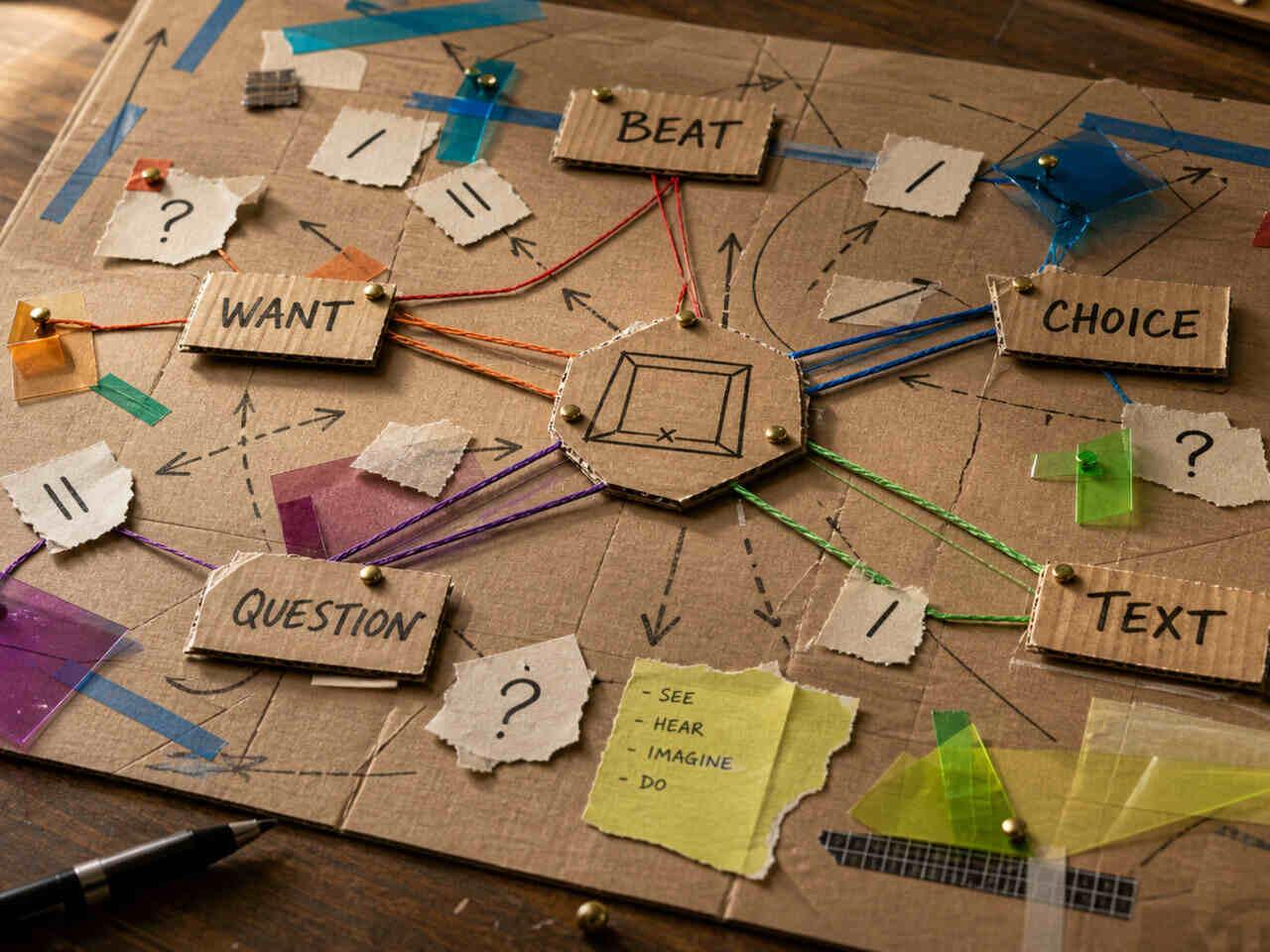
A character breakdown isn't a one-time exercise. It's a working document you return to from the first read to the final dress. The problem most actors run into isn't knowing they need one — it's not having a consistent format that holds up when choices keep shifting mid-rehearsal. Below is a template you can copy for every scene, plus a fully worked example so you can see what a useful breakdown actually looks like.
What a Character Breakdown Actually Covers
The term gets used loosely. Some actors mean a short summary of who their character is. Others mean a full scene-by-scene analysis of objectives, tactics, and obstacles.
For rehearsal, a breakdown that holds up covers three layers:
- Given circumstances — the facts that are active in this scene right now: where you are, what just happened, what's at stake.
- Objective — what your character wants from this specific scene, stated as an action verb. "To convince" is useful. "To feel understood" isn't — it's too internal to play.
- Tactics — how they try to get it, beat by beat. This is the part that changes most between the first rehearsal and the fifth, so leave room to update.
The template below is built around these three layers.
The Template: Copy This for Every Scene
Copy this blank template for each scene your character appears in. Keep it to one page. If it runs longer, trim back to what's actually active in the scene — not what's interesting in the abstract.
When to update: duplicate for each rehearsal block when your choices shift significantly. If your objective changes after a run-through, revise the tactics column on the new copy. If a choice no longer serves the scene, retire it — don't try to preserve it.
CHARACTER BREAKDOWN — [Scene Number / Title] Play / Script: _____________ Character: ___________ Date: _____________
GIVEN CIRCUMSTANCES
- Where are we? _______________
- What just happened before this scene? _______________
- What time pressure exists? _______________
OVERALL OBJECTIVE (for this scene) "I want to _______________"
OBSTACLE "The obstacle is _______________"
STAKES "If I fail, _______________"
TACTICS (list 3–5, beat by beat)
- _______________
- _______________
- _______________
- _______________
- _______________
EMOTIONAL TEMPERATURE AT START: _____________ **EMOTIONAL TEMPERATURE AT END:** _____________
DIRECTOR / REHEARSAL NOTES _______________
UNRESOLVED QUESTIONS (for next rehearsal) _______________
This template works scene by scene. For the layer above it — the through-line want, the relationship map, and the arc across the whole play — fill in the character breakdown worksheet once per role and keep it beside these pages.
More guides on objectives, beat marking, and scene analysis are collected in Script Analysis & Character Breakdown.
A Filled Example — Scene Between Marcus and Lydia
(Original scene — created for this example)
The setup: Marcus comes home late. Lydia is waiting. He owes her an explanation. She's prepared. He isn't.
Below is Marcus's breakdown for this scene.
CHARACTER BREAKDOWN — Scene 3: The Kitchen Play: Original example Character: Marcus Date: April 20, 2026
GIVEN CIRCUMSTANCES
- Where are we? The kitchen. 11:40 PM. The light is still on.
- What just happened? Marcus missed the dinner Lydia had planned for their anniversary. He has a reason — but giving it means opening something else.
- What time pressure? Lydia has a flight at 6 AM. This conversation ends tonight.
OVERALL OBJECTIVE "I want to stay in this relationship without having to explain everything tonight."
OBSTACLE Lydia won't accept a deflection. She has been waiting three hours and she's already decided what she needs to hear.
STAKES If I fail, she leaves in the morning with an answer I can't take back.
TACTICS
- Come in warm — act like lateness is the only issue, not what caused it.
- Minimize — make the missed dinner smaller than it was.
- Redirect — ask about the trip, change the subject before she can set the frame.
- Partial disclosure — give her just enough to slow the escalation.
- Full surrender — if none of it works, tell the truth and deal with what comes.
EMOTIONAL TEMPERATURE AT START: Controlled. He rehearsed this in the car. EMOTIONAL TEMPERATURE AT END: Exposed. His plan collapsed at tactic 3.
DIRECTOR / REHEARSAL NOTES "Don't play the guilt. Play the strategy." — director, after second run-through.
UNRESOLVED QUESTIONS Why does he still come home? What does he actually want from this relationship?
Notice what this breakdown doesn't include: childhood backstory, biographical notes, anything Marcus would never say in the scene. This fits on one page, survives contact with a partner, and gives you something concrete to adjust when a tactic isn't landing.
Get your script into a format where you can jump straight to a scene before you start. Scrolling through a full document to find scene 3 every time you open your notes is friction — and friction is what quietly stops you from updating the breakdown at all.
How to Actually Use the Breakdown in Rehearsal
A breakdown you fill in once and never reopen is wasted work. The document earns its place only if it changes how you rehearse — which means returning to it after every run, not just before the first one.
Use it as a diagnostic, not a trophy. After a run-through where the scene felt flat, open the breakdown and check three things:
- Did the objective drift? If you started playing "to apologize" when you wrote "to stay without explaining," the scene moved without you deciding it should. Pick the one you actually want and rewrite the line.
- Which tactic stopped working? In the Marcus example, the plan collapses at tactic 3. That's not a flaw in the breakdown — it's the breakdown doing its job. Mark where the strategy breaks so you can play the collapse on purpose instead of being surprised by it.
- Is an unresolved question still blank? If you've run the scene four times and "why does he still come home" is unanswered, that's the specific note to bring the director — not a vague "I'm not sure about this scene."
The failure mode to avoid is treating the breakdown as analysis you do beforehand and then abandon. The director's note on Marcus — "don't play the guilt, play the strategy" — only helps if it lands back in the document, where it can reshape tomorrow's tactics. A breakdown that doesn't absorb rehearsal notes goes stale within a week.
Do it in HitCue
- Character assignment: Assign your character to the script so your study session focuses on the right lines from the start — and if you're covering multiple roles, keep them separate.
- Character notes: Store your character breakdown directly in HitCue, attached to the character — not in a separate document that drifts out of sync with your script.
- Character focus view: After completing the breakdown, isolate your character's lines from the full script so you can run through the scene with only your cues visible.
Upload your script, assign your character, and attach your breakdown notes in HitCue — your analysis and your lines in the same place. → Download HitCue