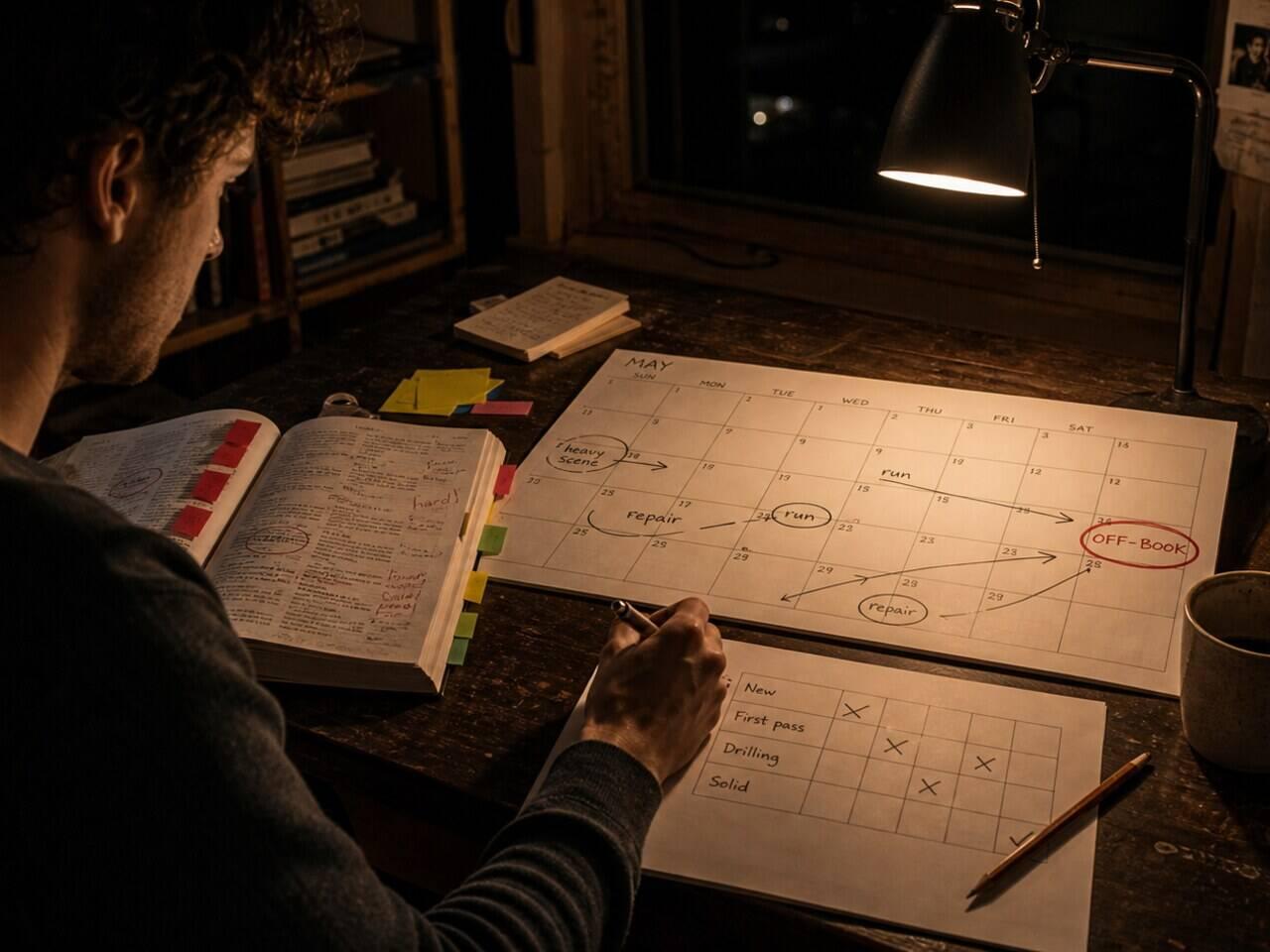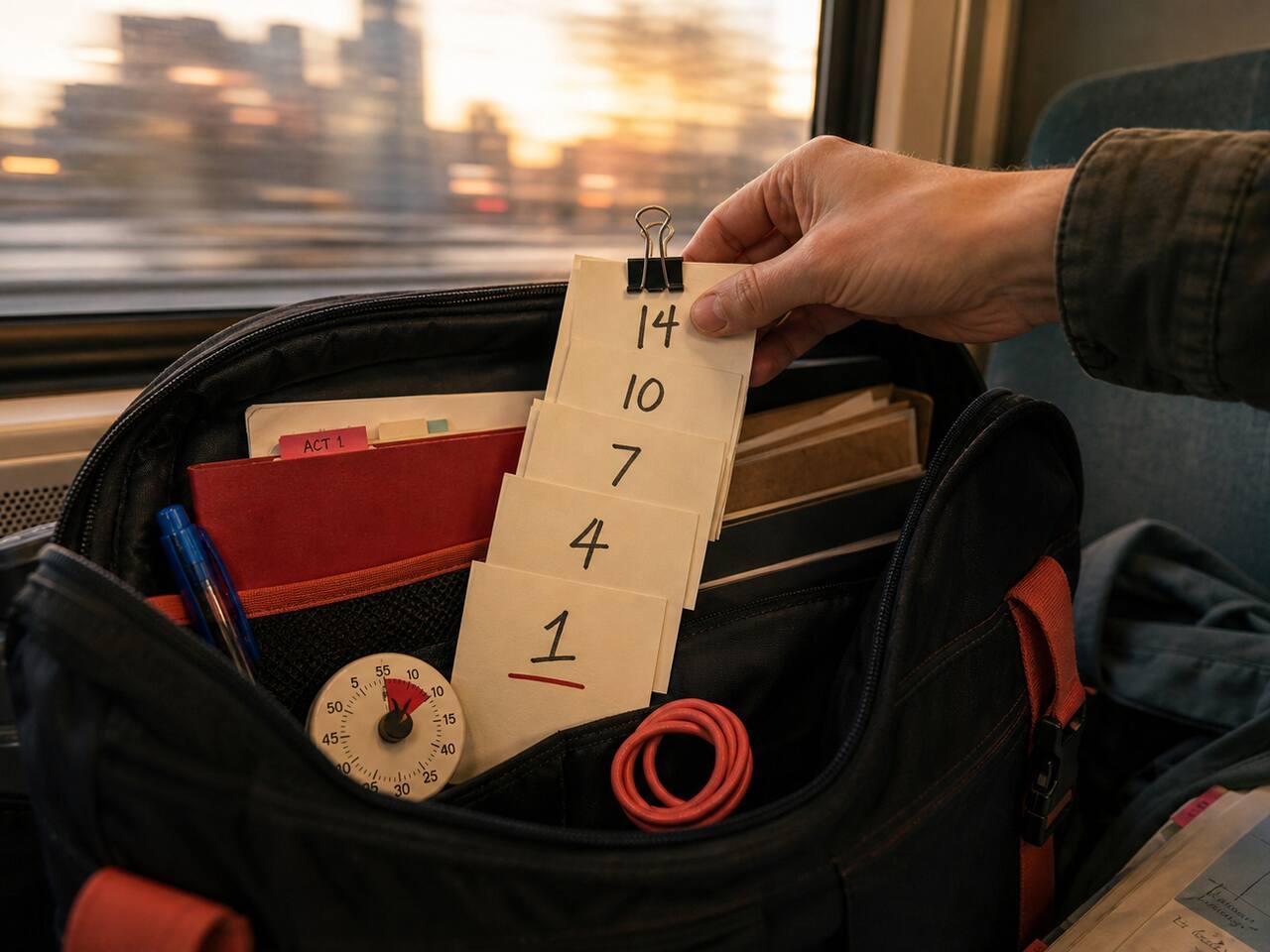
Three days is not enough time to memorize a full script the way you'd do it in a normal rehearsal process. It is enough time to get off-book for a defined set of scenes — if you stop repeating and start building. The plan below is not a trick. It compresses the same logic you'd apply over two weeks into three days. It works if you follow the sequence in order. It fails if you skip Day 1.
The Honest Constraints
Before you start: define the scope. "Memorize the show in three days" is not a plan. "Get off-book for Act 1, Scenes 3 through 6, by Friday night" is.
What three days of focused work can realistically deliver:
- Off-book for the scenes in one act, if your days are mostly clear and the material isn't unusually dense
- Off-book for two or three scenes in a class or studio context, even with a full day job
- A solid working draft for a short piece — not a full-length production
What three days cannot deliver:
- Solidly memorized lines for a full two-hour production
- Lines that hold under pressure if you've only read through them
- Off-book that survives a cold morning — when you haven't run the material in 48 hours
Write your target before Day 1 starts: "By [date], I'm off-book for [specific scenes]." Work that scope only. The rest of the show is a separate problem.
If you want a structured plan for a normal rehearsal timeline, the Off-Book Planning guides cover the full approach — this article is for when you've already run out of time.
Day 1 — Read for Logic, Not for Lines
Most actors who try to memorize in three days start running lines immediately. That's why they fail. Day 1 is not about memorization. It's about building the logical chain that makes memorization possible.
Here's the Day 1 sequence:
- Read the target scenes out loud — once. Don't try to memorize. Listen for what your character wants in each exchange.
- Mark each beat shift in the margin. Where does the tactic change? Where does the emotional temperature shift? A pencil mark is enough — you don't need a formal analysis.
- Name the objective for each scene. Write one line: "I want to ___." If you can't name it, you can't build the chain.
- Read the scenes again — this time in character. You're not memorizing yet. You're internalizing the logic of why each line follows the one before it.
- Do one rough run from memory — with the script available. Look freely when you need to. The goal is to find where the text is consequential (your brain holds it naturally) and where it feels arbitrary (you'll drop it every time).
The arbitrary sections are your Day 2 priority. These are lines where you haven't connected the thought yet. Repetition alone won't fix them — you need the logic first.
Here's an example: your character says "I don't have time for this conversation." But if you haven't identified why this confrontation is happening at the worst possible moment — what's at stake tonight, specifically — that line will disappear every time under pressure. Find the why. The line stays.
Days 2 and 3 — Drill, Test, and Stabilize
Day 2 is the drill phase. The logic chain is built. Now you compress it into reflex.
Day 2 — drill sequence:
- Cover and recall — scene by scene. Cover your lines. Read the cue. Say your line. Check. Don't run the full act as a block — drill one scene until it holds, then move to the next.
- Record the cue lines. Read every other character's lines into a voice memo. Play it back and respond in character. This is the closest substitute for a real partner run when you're working alone.
- Run from memory — with the script available. Don't pretend you're off-book yet. Run the scene, glance when you need to, and mark every line you had to look up.
- Log your drop points. At the end of Day 2, you have a list of specific lines that didn't hold. That list is your only focus on Day 3.
Day 3 — pressure test and stabilize:
Day 3 has one goal: the lines from your drop list have to hold under pressure. Everything else is maintenance.
- Drill only the drop points — in context. Not the full scene. Three lines before, the problem line, three lines after. Repeat until it's automatic.
- Run the full section once without the script. This is your first true off-book test. Pause when you need to. Mark any new hesitations.
- Run it again immediately. The second pass will be cleaner. The first run primes the recall.
- Do a cold test the morning of the performance or next rehearsal. Wait 30 minutes after waking up, then run the lines without a warm-up. If they hold, you're off-book. If they don't, you know exactly what to fix in the hour before.
For the Day 3 drop-point runs, hide your lines one at a time and reveal them only after you've said them — paper, a card, or a blackout view, whatever stops you following along passively. The point is to force the same pressure as a cold run without leaning on the page, because a drill you can peek at trains recognition, not recall.
Do it in HitCue
- Character focus view: keep the emergency pass limited to your highest-risk exchanges, so you are not spending Day 1 rereading pages you will not use.
- Blackout mode: turn Day 3 into a pressure check on the exact drop points you marked earlier, not a full-script confidence pass.
- Dialogue recordings: record cue lines for the scenes you cannot get a partner for, then use every short break for a cue-response drill.
Import your script and run your first Blackout drill on Day 3. If the lines hold, you're off-book. → Download HitCue