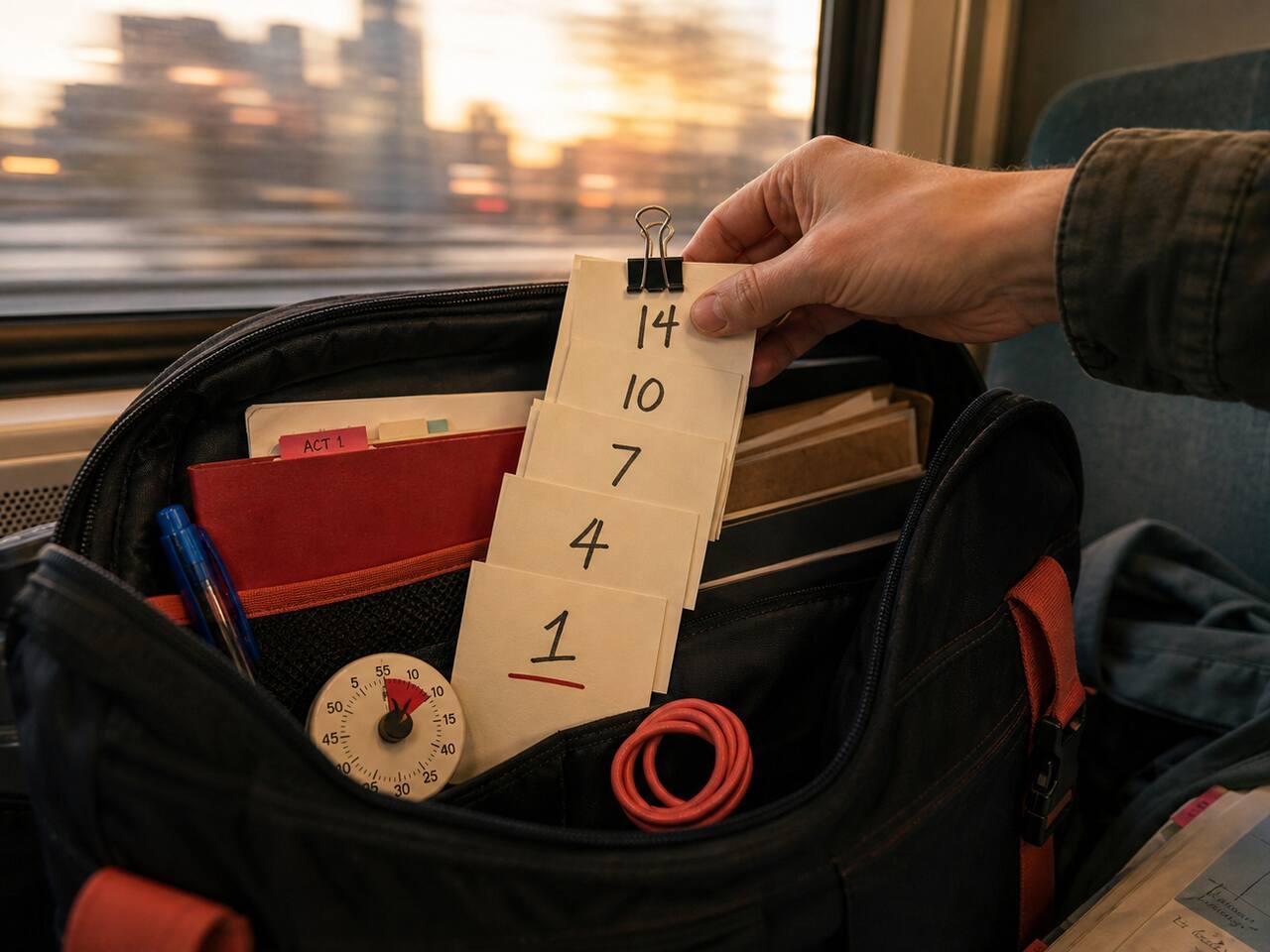
Fast line memorization doesn't come from repeating lines until they stick. It comes from building the logical chain that connects each line to the next — so your memory has structure to hold onto, not just sound. Then testing that chain through short drilling loops that force recall under pressure, before rehearsal finds your gaps first.
This is a two-phase system you can start tonight. It works whether you have two weeks or four days left — though the shorter the window, the tighter your triage needs to be.
Why Repetition Alone Fails Under Rehearsal Pressure
When you repeat a line 40 times in silence, you're memorizing sound — not structure. You can recite it at your kitchen table, but the line disappears the moment a scene partner does something unexpected, a blocking note shifts, or a director gives you a new intention that changes what came before.
Repetition builds recall in a vacuum. Rehearsal happens in context. That mismatch is why lines that seemed locked suddenly aren't.
Cramming creates a second problem: a false sense of readiness. You run the scene once, it comes out cleanly, you stop drilling. Two days later the words are gone. That's because you practiced the words — not the thought that produces them.
Lines stick when your brain has something logical to grab onto. The two-phase system below builds that structure first, then locks it through pressured testing.
Phase 1 — Build the Logical Chain Before You Drill
Before any drilling, spend 10–15 minutes per scene identifying the logical trigger before each of your lines. This is memory work, not acting analysis.
Your character speaks because the other person just made something unavoidable — a question that demands an answer, a challenge that can't be ignored, a statement that shifts the terms of the scene. When you know the specific trigger, the response becomes predictable. Predictable is easy to remember.
How to build the chain:
- Read through the scene and identify what changes before each of your lines — what just happened that made it necessary for your character to speak?
- Write the trigger in your own words next to each line. One sentence is enough.
- Read aloud once connecting trigger to response, without trying to memorize — just confirm the logic holds.
- Close the script. Cue yourself with each trigger and say your lines in sequence.
Example:
In this original example, say you're playing Jordan:
ALEX: You said you'd handle it. JORDAN: I did handle it. You just didn't like how.
Don't memorize Jordan's line by repeating it. Instead, identify what's happening: Alex is making a direct accusation. Jordan's response is clarification, not apology — defensive but certain. The trigger is being accused of failing. The logic is: "I'm not accepting that framing."
That analysis takes 20 seconds. The line becomes structurally predictable. You're memorizing a logical response, not a random string of words.
Apply this to every scene. The initial setup takes longer than a first read-through. The drilling that follows takes half as long.
Phase 2 — Test with Short Loops, Not Full Runs
Once the chain is built, the fastest path to locking lines is short, pressured testing sessions — not passive re-reads or full-scene runs.
Full runs feel productive because you see the whole scene come together. But they let you coast through what you already know and move quickly past what you don't. You finish feeling ready. The gaps are still there.
Short loops force you to confront each weak spot in isolation.
The drill format:
- Pick one scene at a time (3–5 pages maximum)
- Set a timer for 8 minutes
- Test line by line: say the trigger, cover your line, recall it before looking
- Mark every line that takes more than three seconds — those are your current gaps
- Run a second pass drilling only the marked lines
- Rest 10–15 minutes, then test the full sequence cold
In practice, two 8-minute sessions with a gap between them will expose more gaps than one 30-minute repetition run.
Whatever you drill from, hide your lines one at a time and reveal each only after you've attempted it — a cover sheet works, or a blackout view on a digital script. The failure mode to avoid is testing with your lines in peripheral vision: if you can half-see the next line, you're checking recognition, not recall, and the 8-minute loop stops measuring anything real.
Set Your Cadence from the Deadline Backwards
Fast line work doesn't mean last-minute. Even under pressure, count on at least four days of spaced testing as a practical minimum — anything less and you're reinforcing the same short-term recall that fades the moment a scene partner surprises you.
Here's a minimal schedule based on how much time you have:
| Time left | Day 1 | Days 2–3 | Final days |
|---|---|---|---|
| 4 days | Build chain for all scenes | First drill loops, scene by scene — mark gaps | Cold test, then targeted gap work |
| 1 week | Build chain (half the script) | Chain + first drill loop (remaining scenes) | Full gap drill, cold test on day 6–7 |
| 2 weeks | Chain: 1–2 scenes per day for first 4 days | Daily 8-min loops, rotating through scenes | Gap drill day 10, cold test day 12, 10-min daily maintenance |
The rule that makes the system work:
Never skip the cold test. After your last drilling session, wait at least 12 hours — ideally overnight. Then test without opening the script. Whatever drops in a cold test is what drops in rehearsal. Those lines go back into a gap drill, not another full-scene run.
The cold test also tells you whether you're genuinely ahead of your deadline or just hoping you are.
For the full off-book planning approach — including how to structure your schedule around specific rehearsal dates — the Line Memorization Techniques hub covers the complete framework.
Do it in HitCue
- Blackout mode: hides your lines one at a time during drilling — tap to reveal and test yourself under controlled pressure, exactly like the short-loop format above.
- Character focus view: shows only your character's lines from the full script, so your drilling sessions stay focused and your 8-minute loops don't include material you don't need.
- Dialogue recordings: record the cue lines in your own voice so you can run the testing loop alone, without a partner holding the script.
Import your script, activate Character focus view, and run your first Blackout loop tonight — mark every line that takes more than three seconds. → Download HitCue