You should be off-book before blocking rehearsals lock in — not at the first read-through, not the night before opening. The timing matters because going off-book too early puts you in your head about lines when you should be building interpretation, and going too late means you're managing memory when everyone else is refining work.
The rule is tied to rehearsal phases, not to a number of days. Here's how to apply it.
"Be off-book as soon as you can" sounds responsible. In practice, it pushes actors to drill lines before they understand the scene — and that creates a problem.
When you memorize a line before you've worked it, you lock in a delivery. The inflection, the pause, the rhythm all get baked in through repetition. Then blocking starts, the director moves you across the stage on a line you've drilled a hundred times, and the physical action fights the muscle memory. You end up re-learning the line from scratch, just later.
The goal isn't to be off-book early. It's to be off-book at the right moment.
The Three Phases — and When Off-Book Fits Each One
Most productions move through this same broad arc, even when the timeline shifts. Understanding where off-book fits in that arc is more useful than any fixed date.
| Rehearsal Phase | Off-Book Status | Why |
|---|---|---|
| Table work and read-throughs | Script in hand | You're building interpretation, not setting performance |
| First blocking sessions | Working off-book | Your hands and body need to be free |
| Run-throughs and polish | Fully off-book, no exceptions | Line memory is done — the work is refinement |
Phase 1 — Table work and read-throughs: Keep the script. This is where you're figuring out beats, objectives, and the logic of the scene. Memorizing here is premature. You'll lock in choices before the director has shaped the production.
Phase 2 — Blocking: This is the target window. You want to be working off-book by the start of blocking — or at the absolute latest, off-book on a scene before that scene gets blocked. Your hands need to be free. Your body needs to respond to direction, not to the script in your grip.
Phase 3 — Run-throughs: Off-book is not a goal here — it's the baseline. If you're still holding pages during a run-through, you're behind. The work in this phase is nuance, not memory.
Build Your Off-Book Deadline Backwards From Blocking
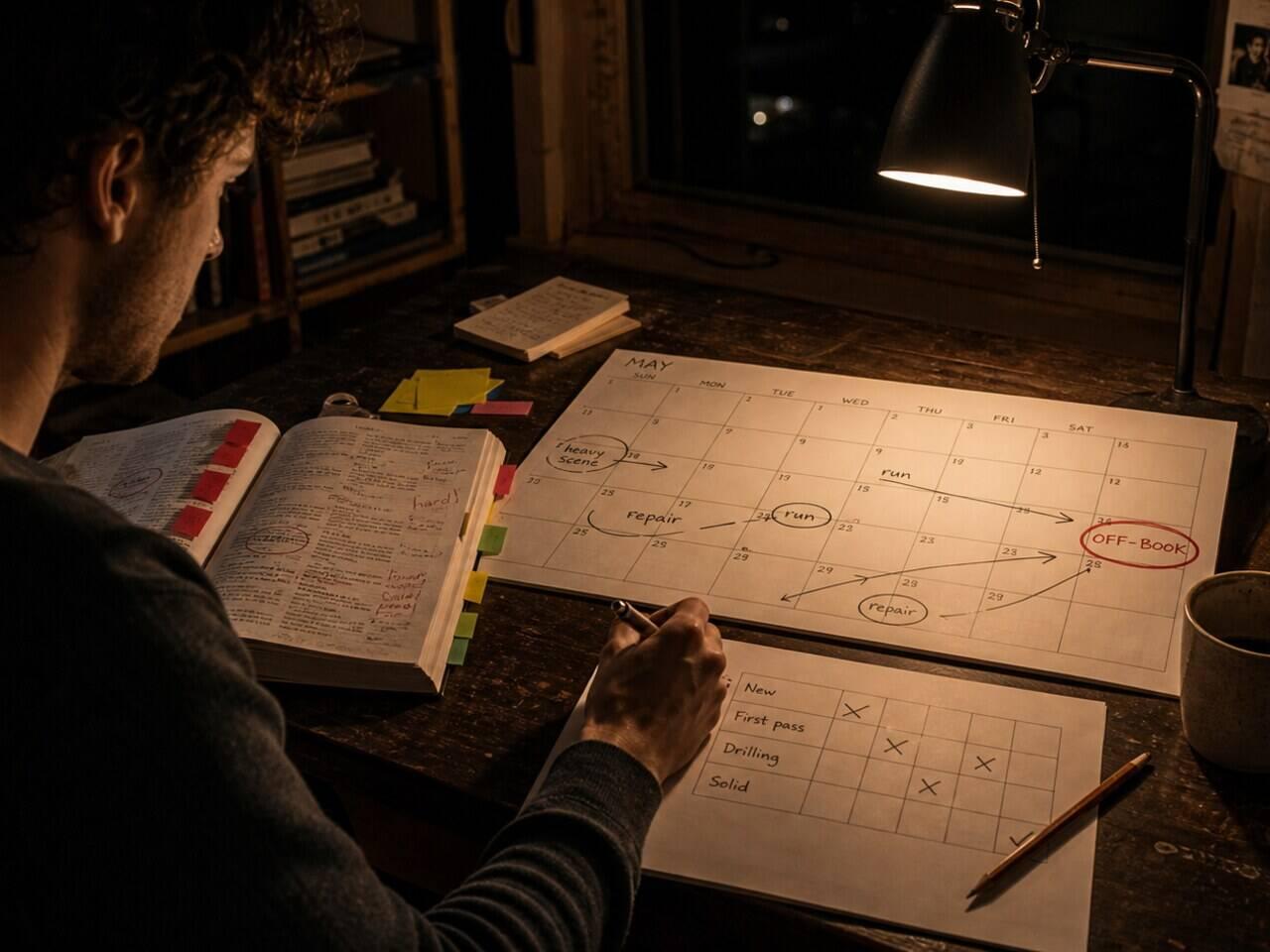
You don't need to memorize the whole script before blocking begins. You need to be off-book on each scene before that scene gets blocked. Here's how to plan it.
- Get the rehearsal schedule. Identify which scenes are being blocked on which days. This is your actual deadline map — not "week three."
- Sort your scenes in blocking order, not scene order. Directors rarely block Act 1 to Act 5 in sequence. Work in the order the schedule gives you.
- Set a per-scene off-book date. For each scene, pick a date two days before its first blocking session. That's when you need to be off-book on those specific pages.
- Calculate your daily load. Count the lines per scene, divide by the days available, and build a daily quota. A manageable target might be ten to twenty lines a day — cramming forty the night before is not.
- Front-load scenes that get blocked first. If Act 2, Scene 3 is being blocked in week one, those are the lines you learn this week — even if they come later in the script.
Here's how this looks in practice. Say your blocking schedule is:
| Blocking Day | Scene | Your Lines | Off-Book Date |
|---|---|---|---|
| Monday (Day 8) | Act 1, Scene 2 | 18 lines | Saturday (Day 6) |
| Wednesday (Day 10) | Act 2, Scene 1 | 22 lines | Monday (Day 8) |
| Friday (Day 12) | Act 1, Scene 4 | 12 lines | Wednesday (Day 10) |
You have six days before the first blocking session. Eighteen lines spread over six days is three lines per session — manageable if you start now.
For a full scheduling system that covers the entire production timeline, the Off-Book Planning hub has the complete framework.
This approach makes the deadline concrete and prevents the last-minute crunch that most actors experience when they treat "off-book" as a single event rather than a rolling target.
The Test That Tells You If You're Actually Off-Book
Most actors think they're off-book when they can read through the script and say the lines correctly. That's not off-book. That's following along.
Real off-book means you can produce the next line without any visual cue — no script, no sides, no prompts. The test is simple: close the script and go. If you need to peek, you're not off-book yet.
The problem is that most actors test themselves by reading, not by performing. You run the lines with the script visible, feel fluent, and conclude you're ready. Then rehearsal starts and the lines disappear.
Testing by hiding the text is more reliable than reading along — you discover exactly where you drop lines before blocking locks them in.
Cover your lines and force yourself to produce them one at a time — paper over the page, a hand, or a blackout view on a digital script. Treat it as a diagnostic, not a drill: if you hesitate before a line, you're not off-book on that line yet. Run it until you don't hesitate.
Do it in HitCue
- Blackout mode: run the deadline test on the scene that was blocked most recently, so you know whether the text holds after movement enters the work.
- Character focus view: review your material around each entrance without letting the full page convince you a line is ready before it is.
- Scene navigation: move through scenes in rehearsal order when you are setting the off-book date, instead of planning from page count alone.
Import your script, activate Blackout mode on your next blocking scene, and find out exactly where you stand. → Download HitCue