Table work is where you lock the logic of the scene before you ever stand up. If you skip it, you'll spend your first rehearsals guessing while trying to move and remember lines at the same time. Done properly, table work gives you clear objectives, turns, and stakes — so when you go on your feet, you're already playing something specific.
This is the checklist to run before your first read-through.
The Goal of Table Work (Before You Touch Blocking)
Table work is not a warm-up and not just a read-through. It's where you answer one question:
What is actually happening in this scene, moment by moment?
If that's unclear, everything slows down later. You'll stop mid-rehearsal to ask basic questions like:
- "Why am I still here?"
- "What changed?"
- "What am I trying to get from you?"
When those answers are already set, rehearsal becomes execution — not investigation.
For the full framework of this phase, see Table Work & Early Rehearsal Phase.
The Table Work Checklist (Run This for Every Scene)
Before you go on your feet, you should be able to answer these. If you can't, the scene isn't ready.
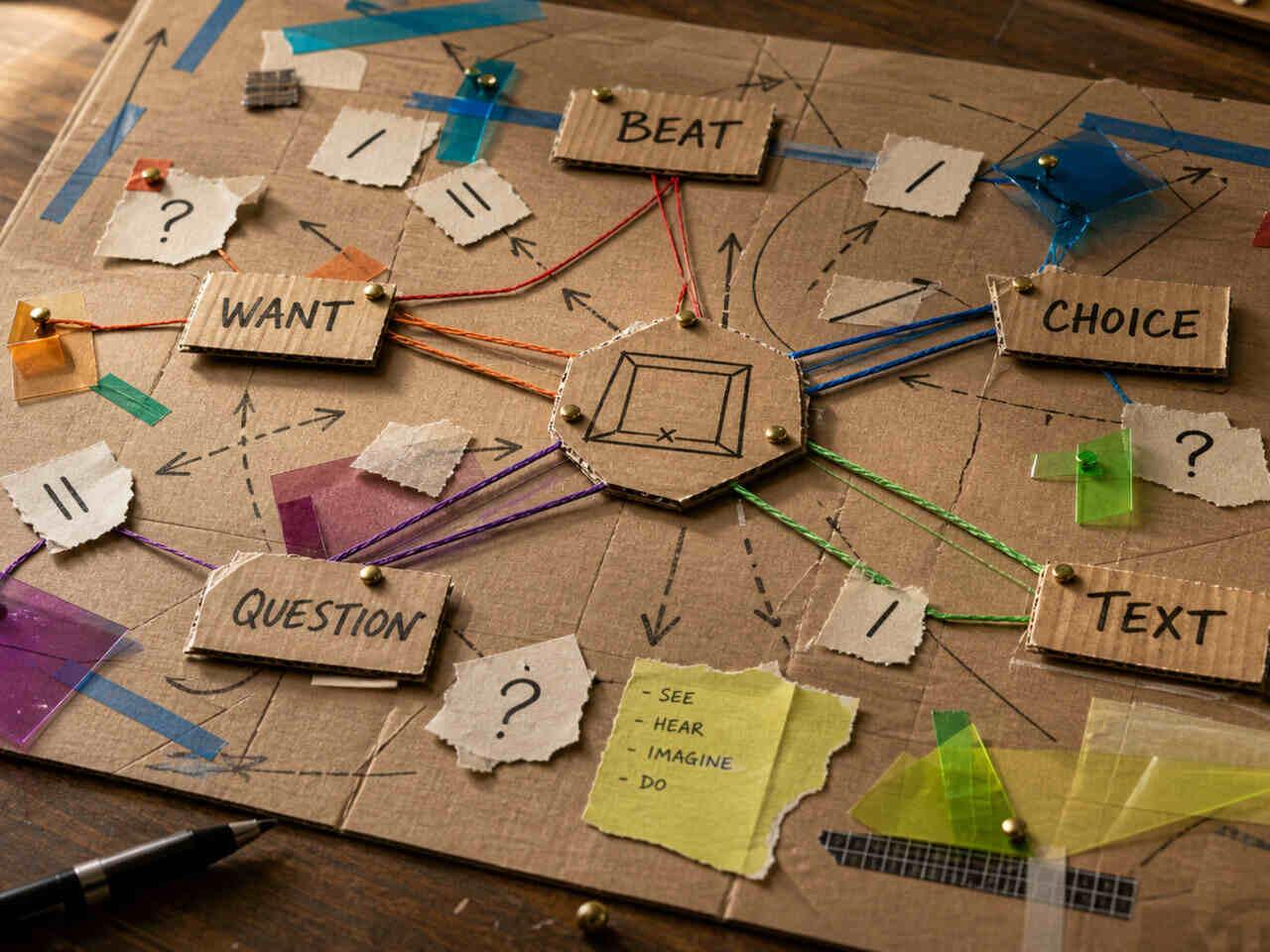
Core decisions (non-negotiable)
- What changes in the scene?
What's different at the end compared to the beginning?
- What does each character want — specifically from the other person?
Not general goals. Immediate, playable objectives.
- Where is the turn?
The exact moment the dynamic shifts.
- What do you leave with?
New information, power, loss, decision — something must change.
Secondary decisions (resolve if they matter)
- Is there a gap between what's said and what's meant?
- Which moments have the most pressure (few words, high stakes)?
- Are there lines that don't make sense yet? Why now?
- What shared history is active in this scene?
Quick example (original scene)
A: You're late. B: I said I'd come. A: That's not the same thing.
At the table, you might land on:
- Change: from expectation → disappointment
- Want (A): get an apology
- Want (B): avoid responsibility
- Turn: "That's not the same thing" — pressure increases
- End: A gains emotional ground, B is exposed
Now when you stand up, you're not guessing. You're playing a clear shift.
Bring Questions — Not Interpretations
Before rehearsal, go through the script alone and write down what you can't explain yet.
Good table work starts with precise questions.
Useful questions
- "Why does my character stay here instead of leaving?"
- "Am I telling the truth or managing them?"
- "Is this turn a surprise or expected?"
Useless questions
- "What am I feeling?"
- "What's the tone?"
- "What does this mean?"
If the question is vague, the answer will be vague — and you won't be able to play it.
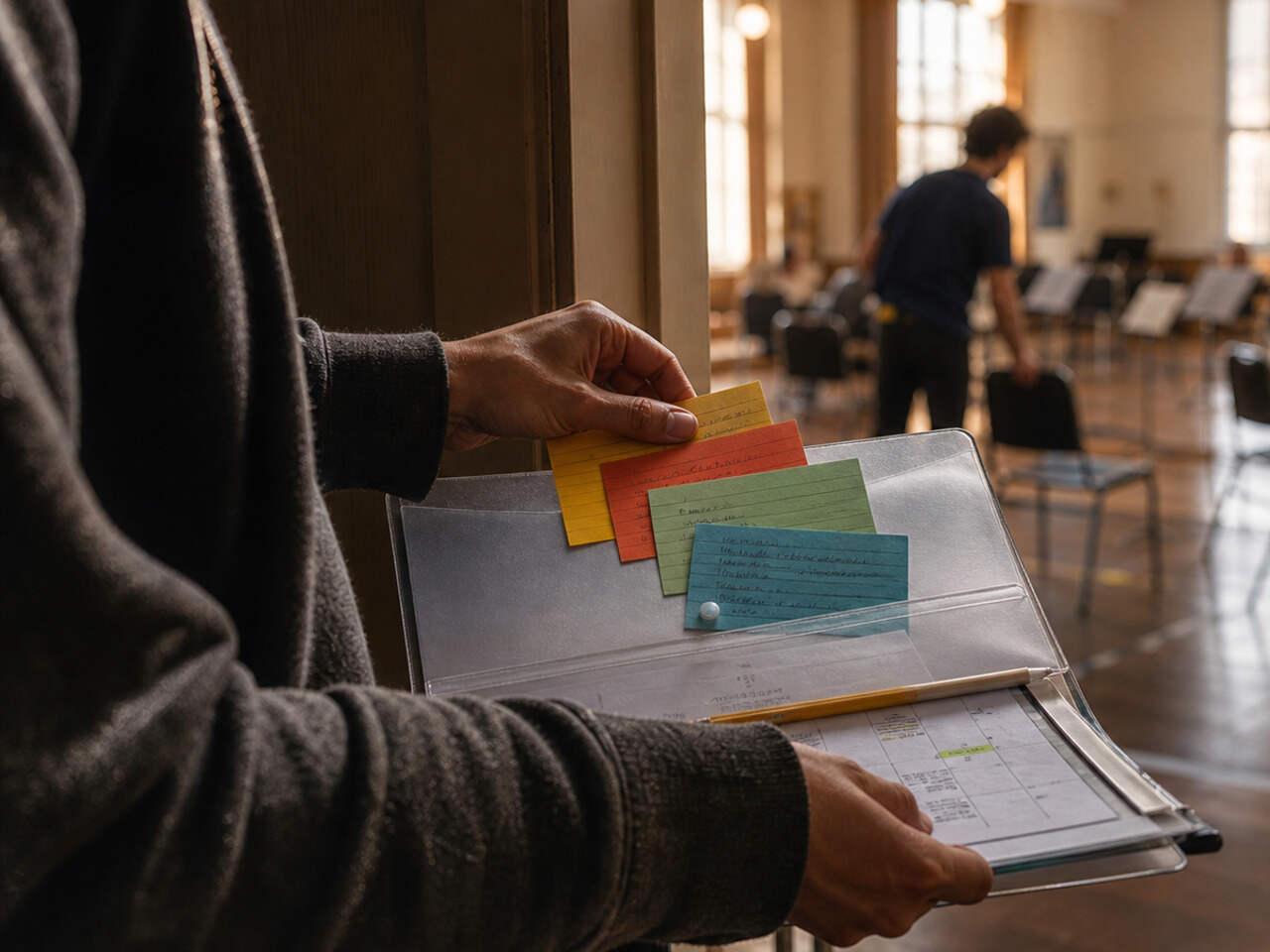
Keep each question attached to the line that triggered it, not on a separate list. A question floating in a notebook gets forgotten by the time you're on your feet; a question pinned to the exact moment surfaces when that beat is actually being worked. Wherever you write them — margin, sticky note, shared document — anchor each one to its line, not to the scene in general.
How to Run the Session (So It Doesn't Drift)
Without structure, table work turns into discussion that never resolves.
Use this sequence:
- Read the scene once
No acting — just hear it.
- Lock the core decisions
Don't move on until they're clear.
- Raise actor questions
One at a time, tied to specific lines.
- Record decisions
Not what was discussed — what was decided.
- Flag what's still open
So it comes back next rehearsal.
Most groups skip step 4. They discuss well, agree in the room, and write nothing down — so the same conversation repeats the next day and the agreement quietly drifts. Capturing the decision in a single line is what makes table work actually hold from one rehearsal to the next.
Where to Put Table Work Decisions (So You Actually Use Them)
If your notes aren't visible during rehearsal, they won't affect your work. A decision written in a notebook you leave in your bag is a decision you'll quietly re-make from scratch next week.
Attach decisions directly to the script:
- Scene arc, turn, stakes → scene-level notes
- Objectives, tactics, subtext → character notes
- Open questions → clearly flagged for next session
The format doesn't matter. The location does.
A filled set of table-work notes for the example scene above might read:
- Scene (Act 1, Sc 2): expectation → disappointment. Turn on "That's not the same thing." A leaves with the upper hand.
- Character (B): wants to avoid responsibility without admitting it. Tactic — deflect, then minimize.
- Open question: does B believe showing up was enough, or is that a cover? Decide on feet.
The point isn't the wording. It's that each note sits on the exact line it governs, so you read it the moment that beat comes up — instead of trying to recall what the room agreed three rehearsals ago.
Do it in HitCue
- Scene notes: attach decisions and open questions directly to each scene so they're visible during rehearsal
- Character notes: track objectives, tactics, and subtext per scene without switching documents
- Shared notes: keep everyone aligned on table decisions without losing them between rehearsals
Import your script and start capturing table work decisions before your first read-through. → Try HitCue