The understudy rehearsal process is a tracking system, not a preparation sprint. You run it in parallel with the production — observing runs, updating notes after blocking changes, drilling alone between other commitments. What makes you ready when the call comes isn't how hard you worked in general. It's whether you have an accurate, current read on which scenes are solid and which ones aren't.
This is that system: a per-scene tracking log you build from first run-through to put-in.
What You're Actually Tracking
There are four things worth tracking, and they're distinct. Tracking one without the others gives you a false read.
| What | Why it matters |
|---|---|
| Text confidence | Do you know the lines without the script in front of you? |
| Cue reliability | Do you know the line that triggers yours — and does it fire correctly? |
| Blocking status | Do you know where the character moves, and what triggers each move? |
| Up to date | Is your version current with what the production is actually doing? |
You can know the text cold and still hesitate on stage because the blocking cue changed last Tuesday and you haven't updated your notes. Staying current matters as much as building confidence.
Phase 1: First Run-Through (Observation)
Your first full run of the production — whether you're in the house or walking a stumble-through — is the fastest data collection point you'll get. Don't try to memorize at this stage. Track the structure.
For each scene you're covering, log:
- [ ] Scene number or title, and approximate running length
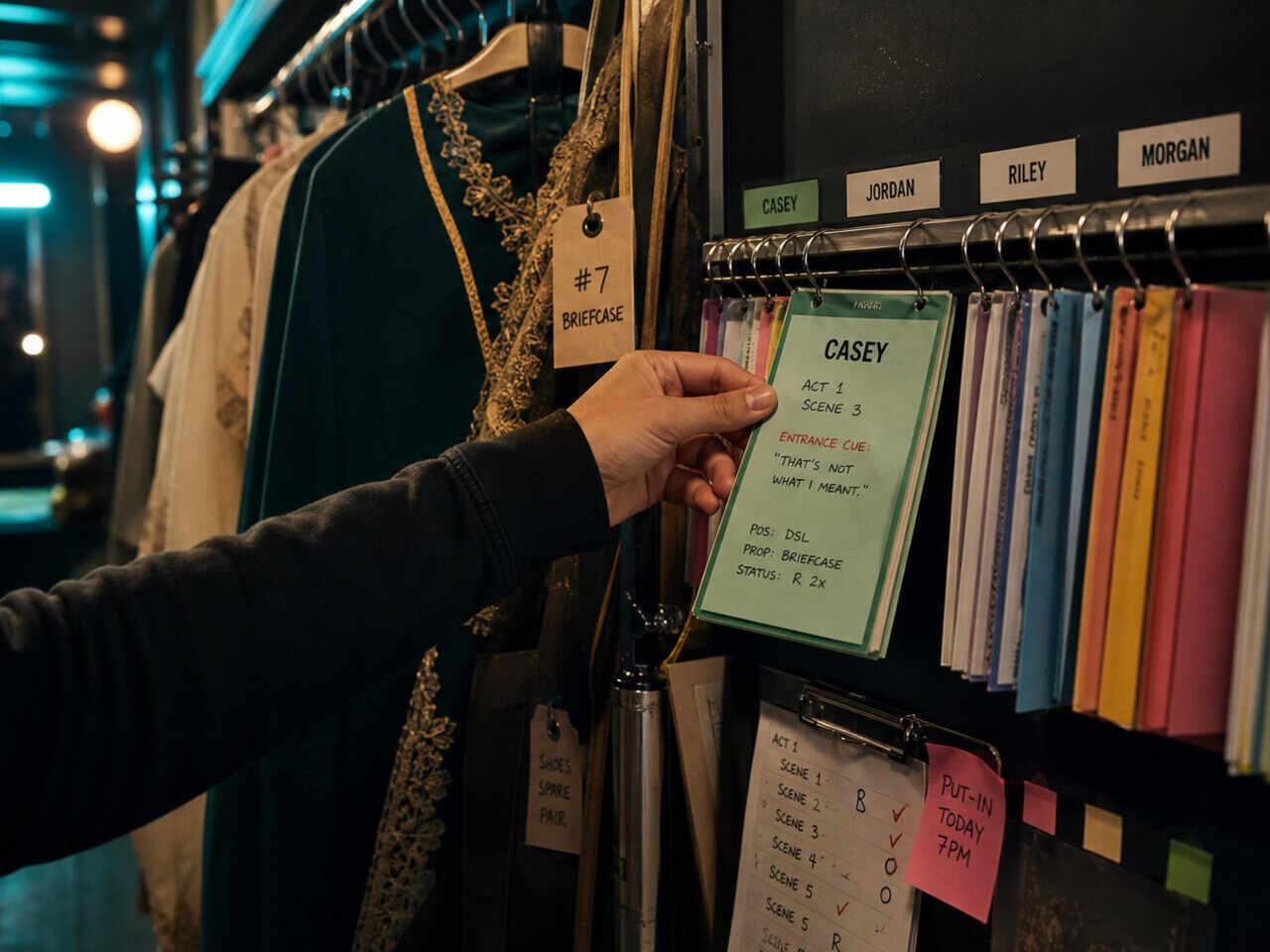
- [ ] Your character's entrance and exit cues (the exact line that comes immediately before)
- [ ] Any cross or position change that happens on a specific word or beat
- [ ] Any scene where the staging is complex — multiple moves, specific props, tight partner positions
You won't have everything after one observation. The point is to know which scenes need simple tracking and which ones need serious tracking investment.
Phase 2: Active Drilling Phase
Once you've done at least one observation pass, the work shifts to per-scene drilling. This is where most of the process actually goes.
For each scene, maintain a status line. Use three categories:
- Not started — no drill pass completed yet
- In progress — text known, cues and blocking still uncertain
- Solid — text, cues, and blocking all hold unaided, on independent testing
Update the status after each session. Don't advance a scene to "solid" until it holds on at least two drill passes on different days. A scene that holds on the day you drilled it may not hold two weeks later if you haven't returned to it.
Per-scene drill checklist
Run this for each scene before marking it "solid":
- [ ] Blackout pass: lines tested one at a time without seeing the text
- [ ] Cue-line drill: cue spoken aloud, line delivered from memory — every exchange in the scene
- [ ] Blocking walk: walked through the full scene using blocking notes only, no script in hand
If any of the three fails, the scene stays "in progress."
If you're covering more than one character, keeping status lines separate per role is where most manual systems break down. Maintain one status table per covered role, never a merged one — the moment you pool progress across characters, "something needs work" replaces "which character needs my next session," and that's the exact information a put-in call demands.
The Understudy & Swing Workflow hub covers the full range of methods for managing parallel tracks — this article focuses on the tracking system you maintain throughout the rehearsal period.
Phase 3: The Two Weeks Before Put-In
If you have advance notice of your put-in date, use the final two weeks for a specific sequence. If you don't — if the call comes with 24 hours' notice or less — Phase 2 tracking is what protects you.
Two weeks out: Run every "solid" scene once in full sequence. Note which scenes feel different when run in order versus drilled in isolation. Some scenes are harder to access when you haven't just come off the preceding one.
One week out: Walk the full show blocking from top to bottom. Identify any transition that feels uncertain — an entrance, a cross, a quick exit. Log it and drill it the same day.
Two days out: Cue-line check for every scene. Has anything changed in the last week? Productions in late rehearsal shift more than people expect.
Day before: One targeted pass through your three least-solid scenes. No full run — just direct contact with the material that's still costing you confidence.
The Tracking Template
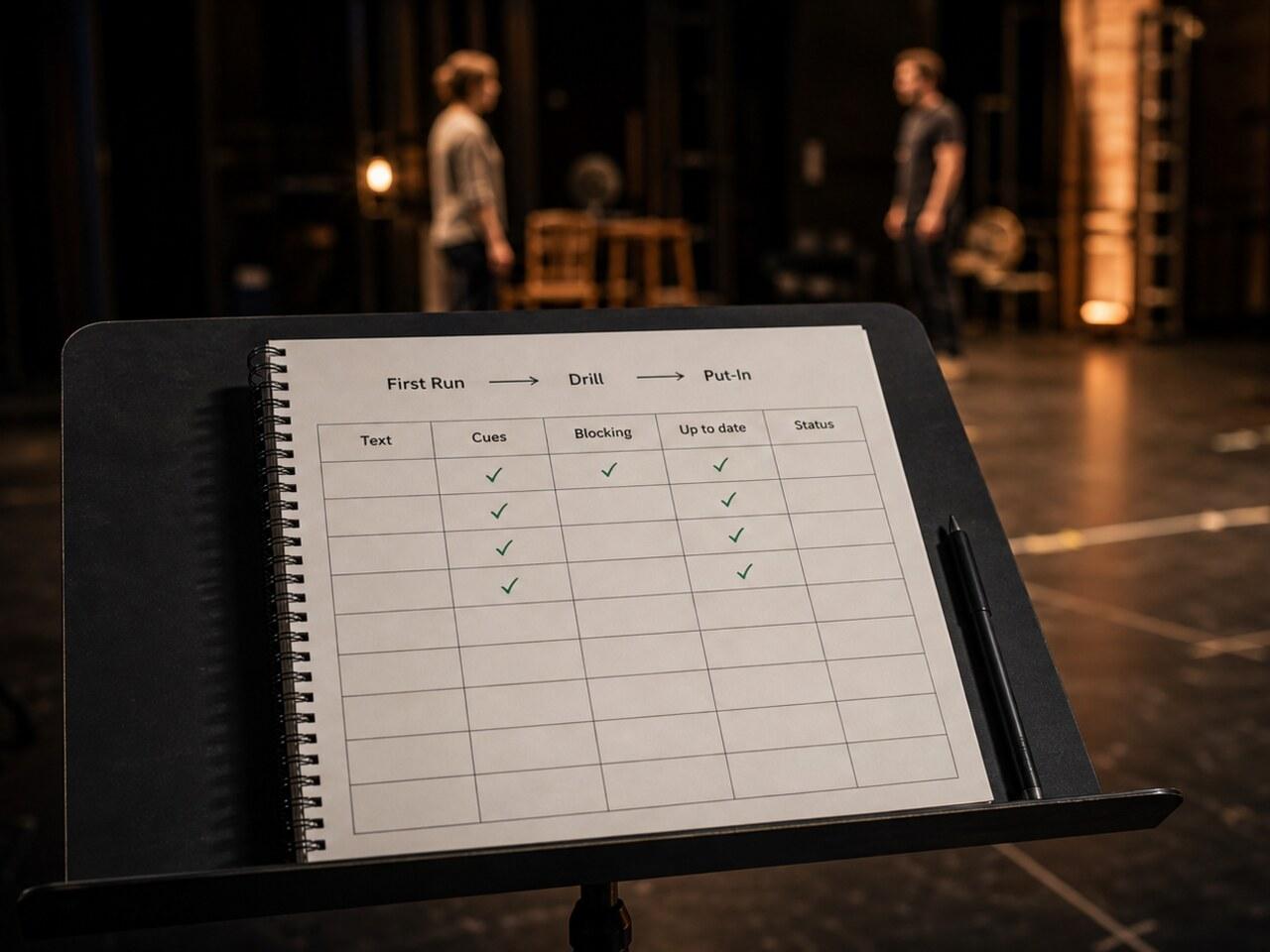
Use this as your standing reference throughout the rehearsal process. One table per covered character.
Here's what a log looks like for an understudy covering one principal role across five scenes, three weeks into rehearsal:
| Scene | Text | Cues | Blocking | Up to date | Status |
|---|---|---|---|---|---|
| Act 1, Scene 2 — MARCUS enters | ✓ | ✓ | ✓ | ✓ | Solid |
| Act 1, Scene 4 — confrontation | ✓ | ✓ | ☐ | ☐ | In progress |
| Act 2, Scene 1 — phone call | ✓ | ☐ | ☐ | ✓ | In progress |
| Act 2, Scene 3 — group scene | ☐ | ☐ | ☐ | ✓ | Not started |
| Act 2, Scene 5 — final exit | ☐ | ☐ | ☐ | ☐ | Not started |
Act 1, Scene 4 needs attention first: blocking changed in the last rehearsal and the version isn't current yet — two columns open at once. Act 2, Scene 1 can follow: text is solid, cues and blocking just need a drill pass. The table tells you exactly where to start each session without having to reconstruct it from memory.
A scene doesn't reach "Solid" until all four columns are checked and it has held on two separate drill sessions.
If you're covering more than one character, run a separate table per role — don't combine them. When you're called to go on, you need to know which tracking applies to which character without any ambiguity.
Do it in HitCue
- Character statistics: track your scene-by-scene progress separately for each role you cover — so you always know exactly where you stand per character, not across all your material at once
- Character focus view: run the active-drilling phase for one covered role at a time, so a solid scene for one track does not hide an untested scene for another.
- Scene notes: attach blocking updates to the exact scene after each observation pass, so "up to date" is something you can verify before put-in.
Import your script, assign your covered characters, and run your first per-scene status check. → Try HitCue