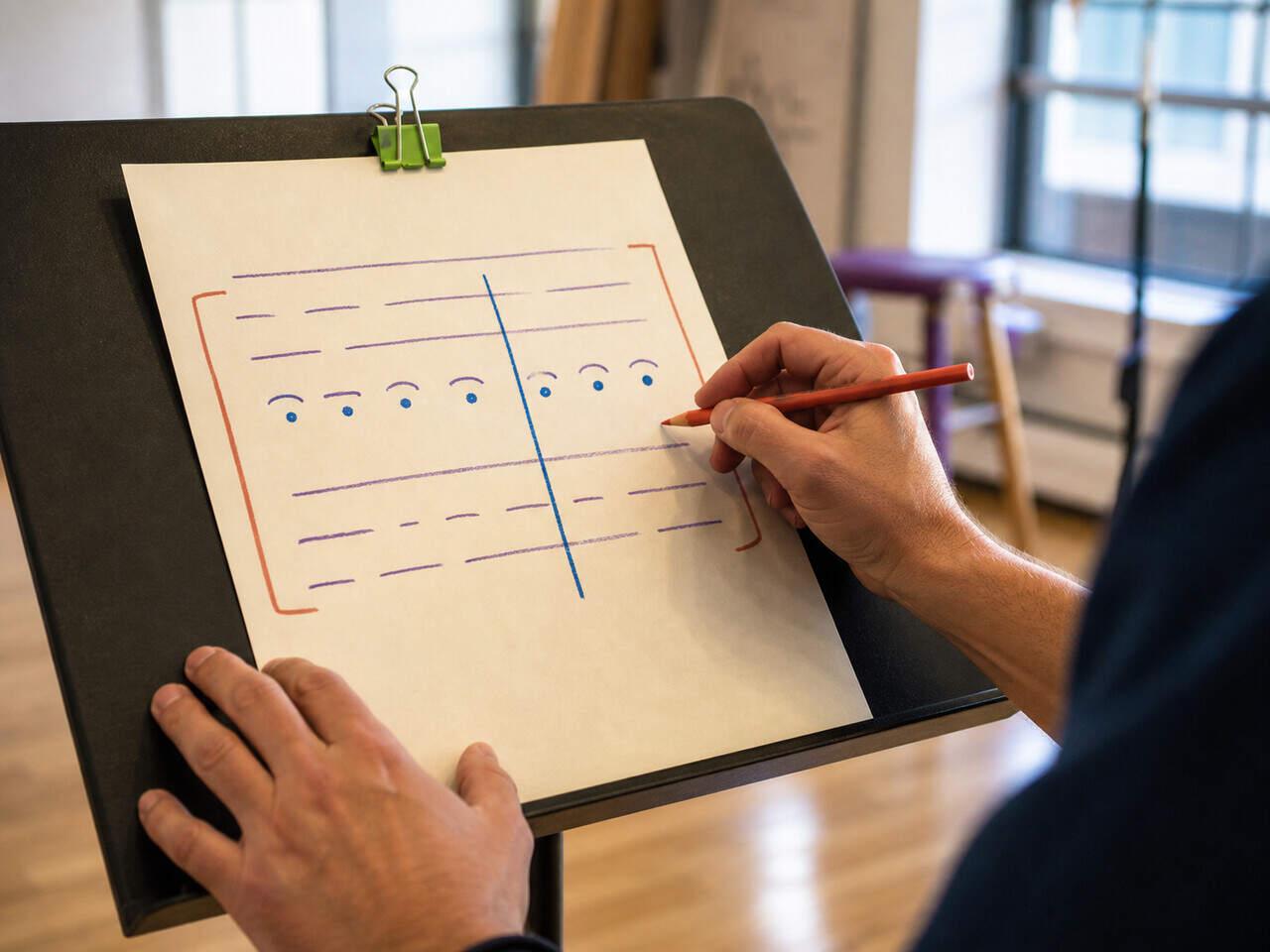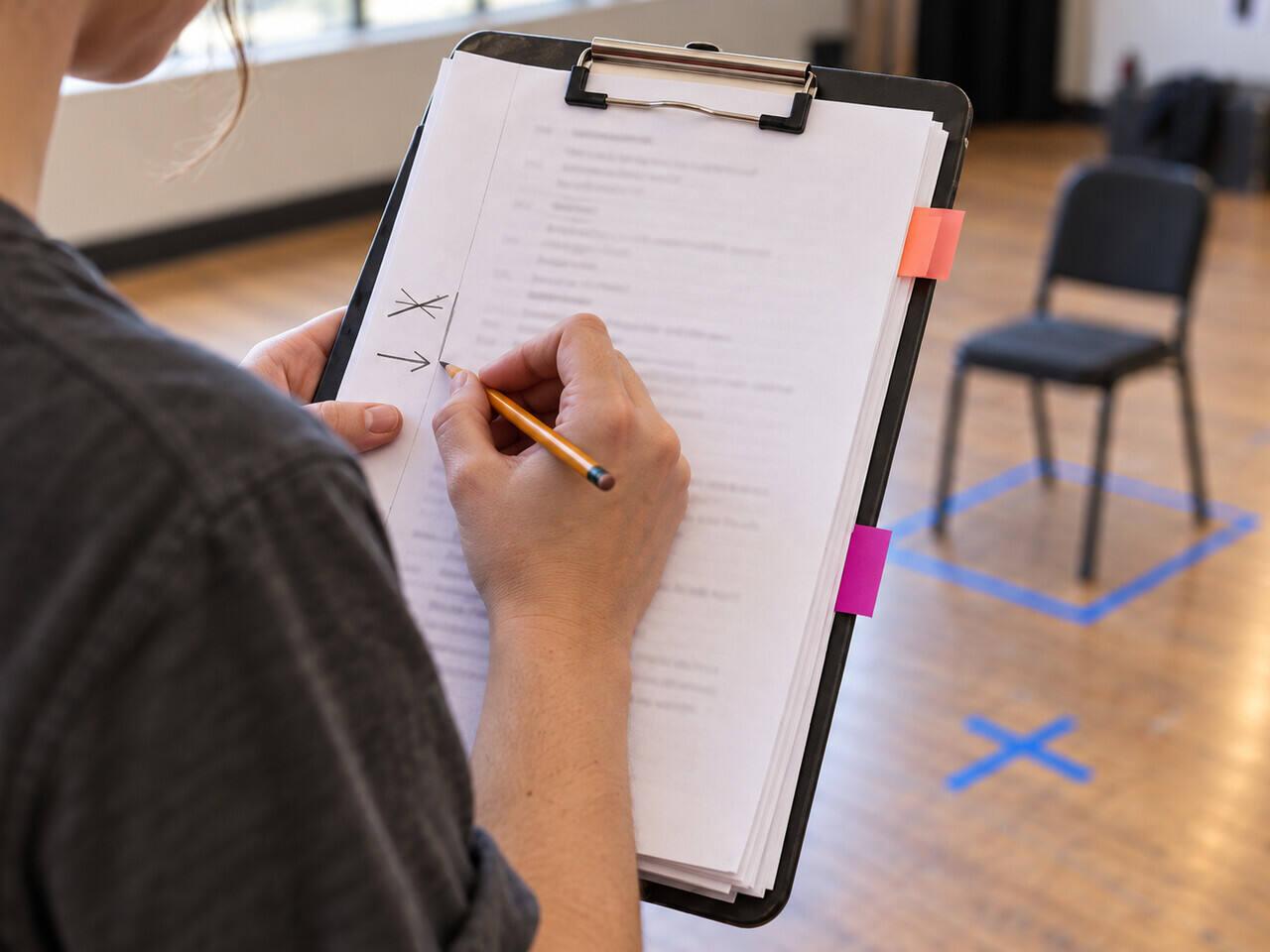
A monologue is a scene with one character speaking. Monologue analysis for actors isn't about finding the meaning of a speech. It's about building the half of the scene that isn't printed: who is being spoken to, what comes back from them, and why your character can't stop. When the speech is aimed at someone, treat each turn as a reaction to them, even when they say nothing. Name the listener first, mark the turns as responses, and the speech stops being a recitation. Here's the pass, filled in on an original monologue.
Name the Listener Before You Touch the Text
A common risk in monologue work is deciding how the speech feels before deciding who it's aimed at. Answer three questions before you mark anything.
- Who exactly? Not "her mother" — the version of her mother who is in the room right now, on this particular evening. The listener needs a face, an age, and a history with your character.
- Where are they? Present in the room, on the other end of a phone, dead, absent, or yourself. This changes everything about the speech's physical life, so decide it and write it down.
- What do they do that keeps you talking? This is the question nobody asks. If the listener gives nothing back, the speech has no engine. Silence counts, refusal counts, a look counts — but it has to be something specific.
Speaking straight to the audience is a legitimate choice, and plenty of plays ask for it. The risk is playing to the house in general, which gives you nothing to react to. Make the audience a specific listener: the jury that just acquitted you, the neighbours who know the family, the people you need on your side before the next scene. Then decide what you want from them and what they give back.
For audition work, keep the listener off the panel unless told otherwise. Place them just past the reader's shoulder, at head height, and hold them there. The specificity is for you; the panel only sees whether you're talking to someone.
Mark the Turns as Reactions, Not as Sections
A turn in a monologue is not a paragraph break. It's the moment your character changes tactic because something came back at them. So the analysis mark goes between the lines, not on them: write the reply you're playing against.
If the speech is a soliloquy, or the turn comes from inside, run the same pass with a different trigger. Write the thought, memory, or discovery that lands between the lines, as if it had been handed to your character by someone else. If you're speaking directly to the audience, give them a specific response to play against, as in the examples above.
Here's an original speech. Ruth has just been told by her brother Aidan that he's selling their father's workshop. He doesn't speak once.
RUTH: Fine. Sell it. You've clearly decided, so I'm not going to stand here and — no. Actually. One thing. When you clear the back room there's a tin under the bench. Don't throw it out. It's screws, mostly. Nothing. But he kept it forty years and I want it. You're doing the face. The one where you wait for me to finish. I'm not asking you to keep the place. I know what it costs. You sent me the numbers twice, in bold. I'm asking you to tell me before the skip arrives, so I can go and stand in it once while it's still his. That's all. Say something.
Now the same speech with the invisible half written in. The text only tells you that Aidan stays silent. His gestures and intentions below are one set of choices to test with a reader, not facts from the page. Change them if another reading gives Ruth more to play against.
| Ruth's line | What Aidan might give back (to test) | The turn |
|---|---|---|
| "Fine. Sell it." | He doesn't argue. | If she expected resistance, getting none takes the purpose out of her exit line. |
| "— no. Actually. One thing." | Nothing. He waits. | She abandons the exit. This is where the speech actually begins. |
| "But he kept it forty years and I want it." | He shifts his weight, as if he might agree. | First real ask, disguised as a small one. |
| "You're doing the face." | He holds still. | Tactic change: she stops asking and starts accusing. |
| "I'm not asking you to keep the place." | He opens his mouth, then doesn't. | She gives up territory to buy the real request. |
| "so I can go and stand in it once while it's still his" | Nothing. | The line she didn't come to say. This is the event of the speech. |
| "Say something." | Still nothing. | The speech ends because he wins the silence. |
In this version, the turns come from what Ruth reads in Aidan's silence. If you can mark a turn without naming what caused it, from the listener or from inside, you've probably marked a paragraph break — the same distinction that separates real beats from formatting in beat analysis.
Find the Line That Costs the Most
A useful test for any monologue: look for two lines, the one the character came to say and the one they didn't intend to say. If you find both, the second one is a strong candidate for the event of the speech. If they're the same line, the event is probably the moment your character finally says it.
Ruth came to ask about the tin. What she didn't intend to say is that she wants to stand in the workshop once while it still belongs to her father. That's the sentence that costs her. Mark it, then make sure everything before it is genuinely trying not to get there.
Two working rules follow from this:
- If you can cut a section and the speech still works, you haven't found its function yet. Test each stretch by deleting it in your head. If nothing breaks, either it's doing a job you've missed or you're playing it as filler. Both are worth fixing before you stand up.
- The costly line doesn't automatically need the biggest delivery. Often the pressure sits in the lines that avoid it, so test both readings before you commit, and let the text and your director decide. Once you know where the speech is heading, the objective and the tactics that come before it become easier to see, because many of them are ways of avoiding the same thing.
This is where the wider script analysis workflow reconnects: the speech has an objective, an obstacle and a shape, exactly like a scene.
Where Monologue Analysis Breaks Down
Four failure modes, in the order they show up in the room.
- You analysed it as a poem. The sign is that it's beautiful and inert. Check whether you can name, out loud, what you want the listener to do by the last line. If the answer is a mood rather than an action, start again at the listener.
- The listener has drifted. You named them precisely early on, and a few runs later they can turn generic again. After each run, say aloud who you were talking to. If you can't, they may have gone, and the speech may start to shorten. Check for it on the next run.
- Every turn is imaginary. You built it alone, so nothing has been tested against a real body. Ask someone to sit in and deliberately give you nothing — no nods, no encouragement. Turns you only imagined may be the ones where you speed up, so notice where you rush and check those passages on the page.
- The cut removed the turn. When you trim a speech for a two-minute audition, the middle is tempting to cut, and that's often where the tactic changes live. Try trimming from the top first, and keep the costly line plus enough of the build-up for the tactic to change before it. A speech with one tactic can feel long even when it's short.
Analysis and memory work are separate jobs, and the order matters. If you memorize first, you risk settling into a fixed reading before you know who it's aimed at. It's safer to build the listener and the turns first, then use them as the trigger chain when you memorize the monologue.
Do it in HitCue
- Character page: if the listener is a character in the play, add them as a relationship — who they are, what they want, and what they refuse to give. If it's the audience, someone absent, or your character's own self, keep the same details in Character notes. Either way, the invisible half of the scene stays specific instead of drifting into a generic listener after a few runs.
- Scene notes: store the finished turn map on the monologue's scene, with the reply you're playing against at each turn, so the speech keeps its scene structure on the nights you rehearse it alone.
- Dialogue recordings: record the monologue and listen back for where the tactic or the thought changes, then check any stretch where nothing seems to shift against the text to see whether a turn is there and not yet played.
Import the play, write down who your listener is, then record the speech tonight and check the first passage where you can't hear the tactic change against your turn map. → Download HitCue