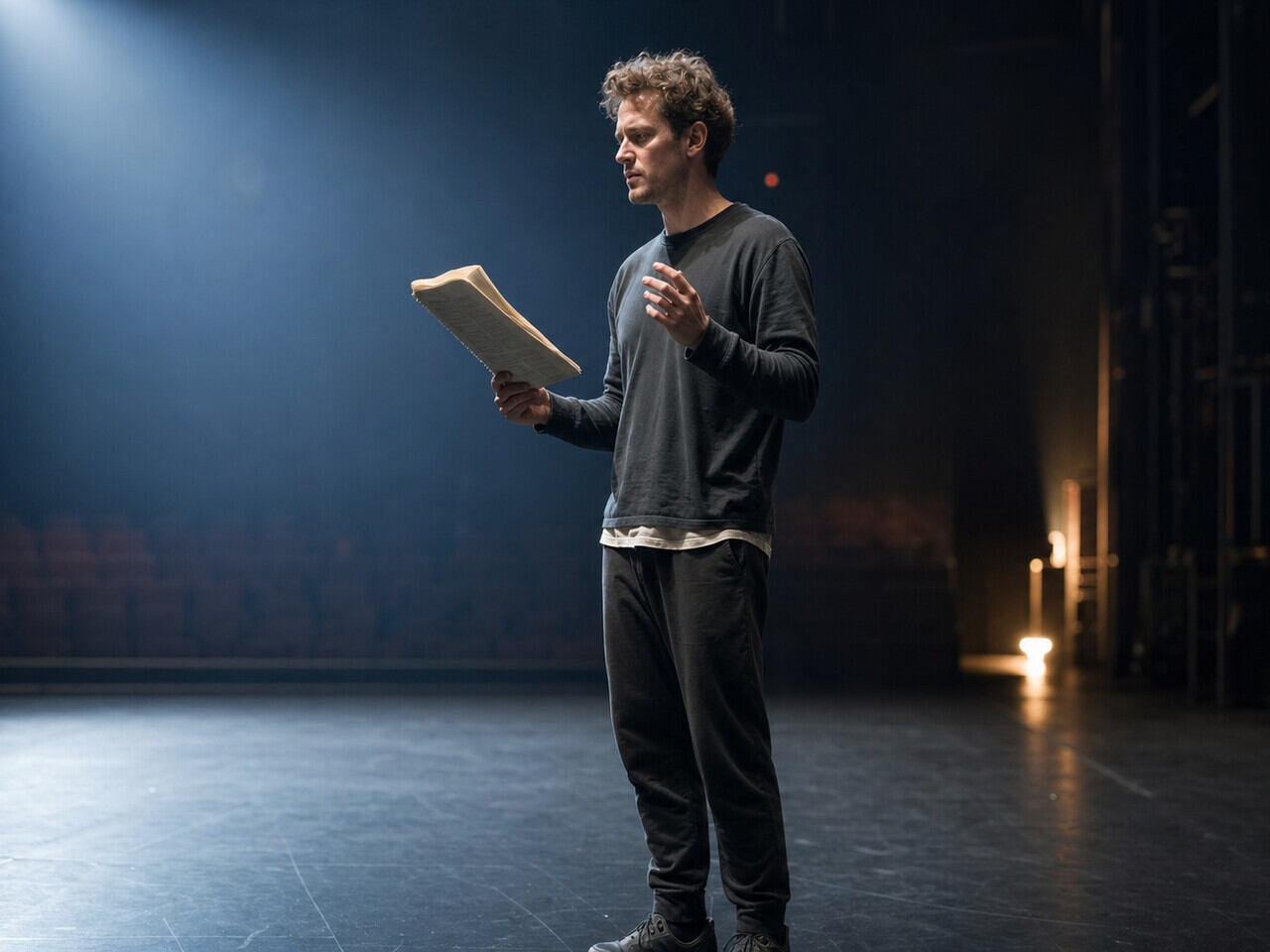
Community theatre runs on borrowed time: two or three rehearsal evenings a week, squeezed around everyone's day job, with a volunteer director juggling eighteen people and a costume crisis. Nobody is tracking whether you're off-book — that's on you. So the most useful community theatre tips for actors aren't about acting harder; they're about self-managing the prep the production won't manage for you. The four systems below turn thin, scattered time into steady progress: your own off-book deadline, short solo sessions, a defense against version chaos, and a week-by-week plan. For the cast-level workflow around sharing scripts, notes, and rehearsal expectations, use the community theatre preparation hub.
Set Your Own Off-Book Deadline Before the Director Asks
In a professional room, someone tracks individual progress. In community theatre, no one does — the director is a volunteer managing everyone at once. If you reach run-through week still on book, that's your problem to explain, and it slows the whole cast.
So build your own off-book schedule in week one, before anyone asks for it. Work backwards from the first run-through. Set a soft off-book date for each scene — rough, calling "line" allowed — about two weeks out, and a hard date — no book at all — a week before the run.
The community-theatre-specific rule: set the soft date a full week earlier than feels necessary, because in amateur productions life cancels rehearsals. A castmate's kid gets sick, the venue double-books, someone quits in week three. Assume you'll lose a week you didn't plan to lose. If your buffer survives, you're early; if it doesn't, you're still on time. For the backward-planning mechanics, see off-book rehearsal plan.
Make the Days Between Rehearsals Count
You have maybe three rehearsal evenings; you also have five other days. Those five are where community theatre actors actually get off-book. The unit that fits a real week is 20 minutes — a lunch break, a commute, after the kids are down — done consistently. Short, regular sessions are easier to repeat than one weekend cram, and they survive a chaotic schedule far better.
A 20-minute session that fits a commute:
- 0–5 min: read the entry and exit cues for the scenes you're working — orient before you run anything.
- 5–15 min: drill cue → response. Cover your lines, say your part only after the cue lands, and look up when you blank instead of skipping past it.
- 15–20 min: one full pass of your hardest scene, no book, noting where you hesitate. Stop at 20 — a fresh session tomorrow beats grinding through fatigue tonight.
The catch in community theatre: your scene partner has a day job too, so you can't count on running cues together midweek. Don't let that stall you. Record their cue lines once — a phone voice note is enough — and play them back to drill cue-and-response alone. That trains the trigger-to-response link a real scene uses, which is exactly what collapses when you've only ever run full speeches in order. Waiting until Saturday to do cue work is how you arrive at rehearsal knowing your lines cold and still drying up the moment your partner phrases the cue differently than you did in your kitchen.
Protect Yourself From Script Version Chaos
Community theatre scripts arrive in pieces: three emails, two PDFs, a handwritten change on page 47. The director cuts a scene in week three and tells only whoever was in the room that night. By week two, no two people have the same file — and the coordination overhead lands on you personally, even when it isn't your fault.
You can't fix the whole cast's chaos alone — that's a coordination problem, covered in how to share a script with your cast. But you can protect your own prep:
- Drill only from the version that will be in the room. After the first production meeting, ask the stage manager which file is definitive and work from that — not the PDF you downloaded in week one. Memorizing a speech that's already been cut is the most demoralizing way to lose a week.
- Log blocking changes the same night, pinned to the scene. Not tomorrow, not "I'll remember." A 90-second note tied to the exact scene. Blocking you don't capture that evening is misremembered or gone by Thursday.
- Re-confirm before each hard off-book date. Before you lock a scene, check it against the current file. Late cuts orphan cue lines — a cue you've drilled for two weeks can simply vanish, and you want to discover that before the run, not during it.
A Week-by-Week Mini-Plan for a 6-Week Run
Put the three systems on one timeline. Here's a mini-plan for a typical six-week amateur production with the first run-through around week four. Adjust the weeks to your own schedule, but keep the shape: deadlines early, solo sessions constant, version checks before every lock.
| Week | Off-book target | Between-rehearsal sessions | Version check |
|---|---|---|---|
| 1 | Mark your scenes; set soft + hard dates | Read-throughs; build your cue list | Confirm the definitive file |
| 2 | Soft off-book: Act 1 | 20-min cue drills, Act 1 | — |
| 3 | Hard off-book: Act 1; soft: Act 2 | Cue drills, Act 2; record solo cues | Re-check before locking Act 1 |
| 4 | Hard off-book: Act 2; first run-through | Full-scene passes, hardest scenes | Re-check before locking Act 2 |
| 5 | Hold off-book through blocking changes | Integrate notes; drill trouble spots | Log every cut the night it's called |
| 6 | Dress, preview, opening | Light maintenance passes only | Final file matches what's on stage |
If a week gets eaten — and one usually does — protect the hard off-book dates and let the soft ones slip. The soft date is a rehearsal for the deadline; the hard date is the deadline.
Do it in HitCue
- Blackout mode: test each scene solo between rehearsals — it hides your lines until you tap to reveal, so you find out exactly where you blank before the run does it for you.
- Dialogue recordings: record your partner's cue lines once and drill cue-and-response alone on any of your five non-rehearsal evenings, with no schedule to coordinate.
- Scene notes: capture each blocking change the night it's called, pinned to the scene, so it's still accurate on Thursday instead of half-remembered.
Upload your script, record your partner's cues, and run your first 20-minute Blackout drill tonight. → Download HitCue