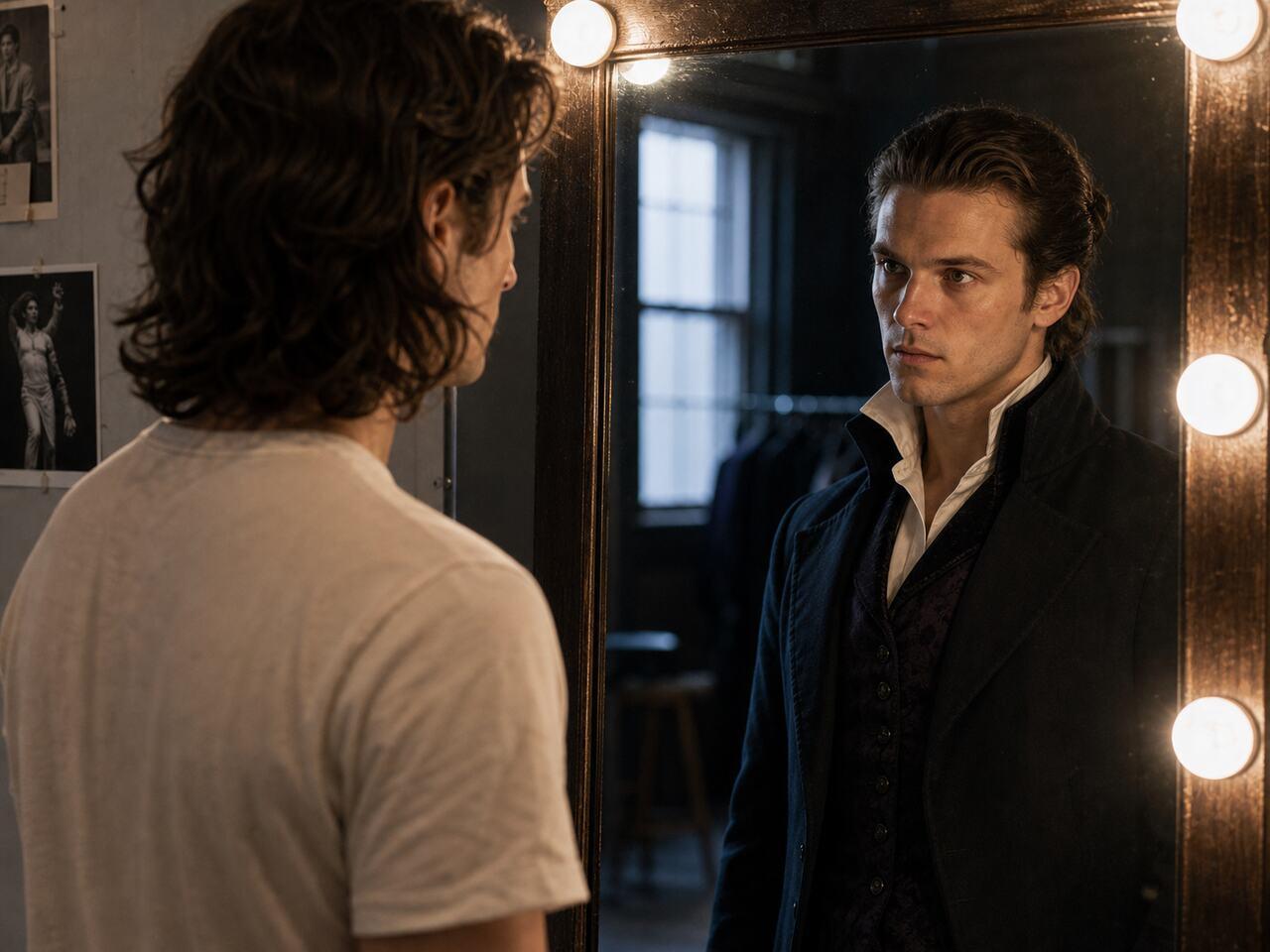
Practical Aesthetics gives you one job in a scene: figure out the action you're playing, then go play it. You don't manufacture the feeling first. You name what your character is literally doing, boil it down to a plain action anyone could play, and let the emotion arrive on its own. This is the method for the actor who freezes trying to "feel" a scene the night before class. Below is the three-question analysis, filled in on an original scene, plus the two ways it quietly goes wrong.
The Three Questions That Turn a Scene Into an Action
Practical Aesthetics was developed by David Mamet and William H. Macy, drawing on influences that include Stanislavski and Meisner, but you don't need the history to use it. You need three questions, answered in order, before you stand up.
- What is the character literally doing? Describe the events of the scene like a police report. No interpretation, no adjectives. Who does what to whom.
- What is the essential action? Ask what your character wants the other person to do — a concrete thing, not a mood — then compress it into a plain "to ___" phrase any actor could play without reading the play. This is the reusable core.
- What is it as-if? One sentence from your own life that makes the stakes real: "It's as if my _ did _ to me." You never act out this memory. It just raises the temperature.
The whole method lives in the second question. If your essential action is doable, the scene has a motor. If it's a feeling, you've got nothing to play. The script analysis hub covers the wider breakdown, but Practical Aesthetics is deliberately narrow: it refuses to let you rehearse emotion directly.
Write the Analysis: A Filled Example
Here's an original scene. Mara comes back to a flat she moved out of, to collect a box she left behind.
MARA: You changed the locks. JONAH: The landlord did. Last week. MARA: And nobody called me. JONAH: You moved out in March. MARA: I left a box. That's not moving out. JONAH: Then take the box, Mara.
Now the three answers, written for Mara. To reach the essential action, ask what she wants Jonah to do — let her back in — then strip the names off it so anyone could play it.
| Question | Answer for Mara |
|---|---|
| What is she literally doing? | She returns for a box, finds the locks changed, and is told to take her things and leave. |
| Essential action | To make someone let me back in where I still belong. |
| As-if | It's as if the friend I started a business with changed the office locks and told me to collect my things from the lobby. |
Notice the essential action never mentions Mara, Jonah, or the flat. That's the point. "To make someone let me back in where I belong" is playable by a stranger who's never read the scene. You could hand that phrase to any actor and they'd know what to do with their eyes, their voice, their next move.
Compare playable actions with the ones that trap you:
| Not playable (a state) | Playable (a doable action) |
|---|---|
| To feel betrayed | To make someone admit they cut me out |
| To be hurt | To force someone to take me seriously |
| To show I'm angry | To get someone to undo what they did |
| To seem confident | To make someone hand me what's mine |
The left column describes how you'd like to look. You can't play any of it on purpose without indicating. The right column is transitive — it lands on the other actor and gives you something to pursue for real.
Play the Action, Not the Feeling
Once the analysis is written, you throw most of it away in the room. You keep the essential action, you point it at your scene partner, and you go get the thing. The as-if runs quietly in the background — you do not perform it, narrate it, or revisit the memory mid-scene.
Two operating rules keep this clean:
- The stranger test. Say your essential action out loud. If someone who's never read the play couldn't stand up and play it, it's still a mood. Rewrite it as a verb you do to another person.
- Cap the as-if at one sentence. If your "it's as if" needs a paragraph of backstory to land, it's too big and you'll disappear into it. One line, then close the notebook.
This is why Practical Aesthetics sits comfortably next to plain objective-and-tactics work — the essential action gives you something to pursue, much like an objective, and each attempt to get it behaves like a tactic you can adjust live. If you want to layer that in, the tactic side is covered in how to build objectives and tactics you can reuse.
Where the Method Backfires
Practical Aesthetics fails in two predictable ways, and both are easy to catch once you know the signs.
The as-if turns into emotional memory. You start the scene, the personal analogy takes over, and your attention drifts inward. The tell: your eyes lose the other actor and you stop adjusting to what they give you. The scene goes private and dead. Fix it by dropping the as-if entirely for a run — keep only the action, put every ounce of attention on getting the thing from your partner. The feeling comes back once you're chasing something real.
The essential action is secretly a feeling. You wrote "to feel abandoned" and dressed it up. You can't play "to feel." If a run keeps stalling, check your phrase: does it end in a state, or in something the other person could actually do? Rephrase it as an action that lands on them, and the scene moves again.
One more from real prep: don't let the analysis eat your rehearsal time. This is a lean method on purpose. If you've got a scene due in three days, spend twenty minutes on the four questions, write the action on the page, and get on your feet. The point is to stop chasing emotion, not to build a longer document to hide behind.
Do it in HitCue
- Scene notes: write the essential action and one-line as-if on the scene you're preparing, so the doable action is in front of you the moment you run it.
- Character notes: keep the character's recurring want in one place, so the same essential action carries scene to scene instead of being re-invented each rehearsal.
- Character page: store the essential action as the character's objective, next to relationships and emotional arc, so your analysis stays attached to the role, not a loose sheet of paper.
Open your scene, mark the essential action on the moment you usually chase the feeling, and run it as a doable action pointed at your partner. → Download HitCue