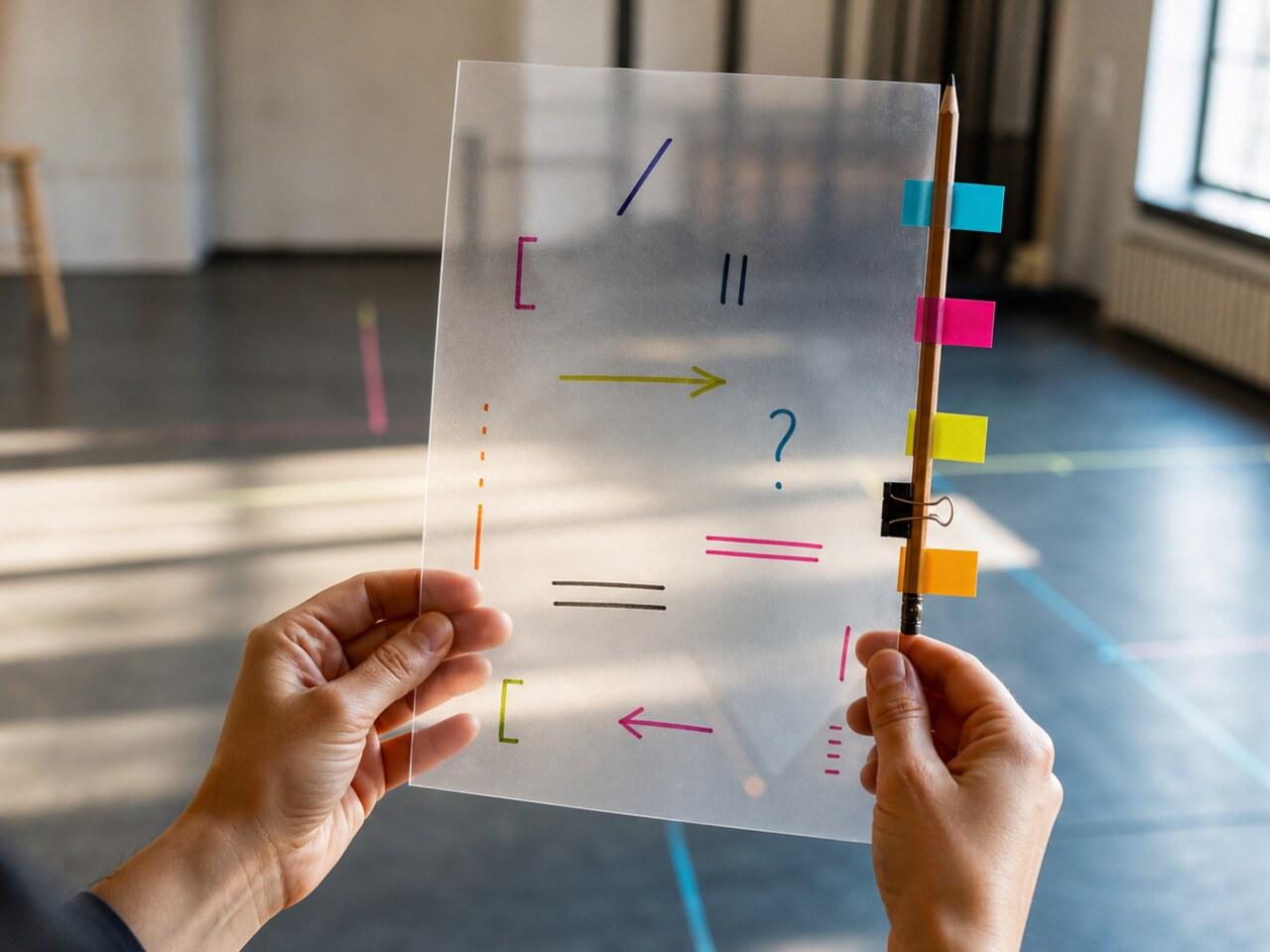
A script annotation legend is the short list of symbols you keep inside your script so every mark means one thing from page one to the curtain. This page gives you what a plain symbol list doesn't: a fill-in legend card to copy into your script, a page marked line by line, and the extra marks — breaths, exits, moves, cuts — that most cheat sheets skip. Download the printable legend card (PDF), then keep it inside the front cover of your script. For what each core symbol means and how the habit is built, the script annotation symbols guide is the reference; this page is the worksheet you fill in and keep.
The fill-in legend card
Copy this onto the inside front cover of your script, or write it on an index card and tape it there. Keep it to one line per mark so you can find it in week four, when your annotations start to look like a foreign shorthand. These are the core marks, and they follow the same conventions as the guide — so a slash means the same thing on the page and in your notes.
| Mark | Means |
|---|---|
[ | Your cue line |
/ | Beat change |
// | Held pause |
* | Emphasis, above the word |
| Underline | A physical action tied to the line |
→ | Another character enters |
? | A choice you haven't made yet |
D: | Director's note |
Prefer your own glyphs? Copy the blank card, fill the right column once, and then leave it alone for the whole script. The rule isn't which symbol you pick — it's that one mark never means two things.
| What it marks | Your mark |
|---|---|
| Your cue line | |
| Beat change | |
| Held pause | |
| Emphasis | |
| Physical action | |
| Entrance | |
| Open choice | |
| Director's note |
Marks a basic cheat sheet skips
Most symbol lists stop at beats, cues, and emphasis. These seven cover what actually comes up once you're on your feet — timing, movement, and the changes that arrive in the room.
| Mark | How to draw it | What it marks |
|---|---|---|
' | A small tick above the word | A breath — where you take air before the line |
| Link line | A curved line under two words | Run them on, no pause between the thoughts |
← | An arrow out, in the margin | Another character exits |
M: | A short note in the outer margin | A move or blocking change |
P: | A short note beside the line | A prop you pick up, hand over, or set down |
| Strike-through | A line through the words | A director-approved cut — text you're no longer saying |
! | In the inner margin | Come back to this: a choice still unresolved |
Keep these in the same hand as your core marks, and add each one to your legend card the first time you use it.
A worked example, marked line by line
Here is a short original scene with the system on it, and what each mark tells you when you read it back. The symbols you can type are shown inline; two more live on the paper and are noted below.
| Line, as you'd mark it | What the marks tell you |
|---|---|
[ REY: You still have the key. / I can see it in your hand. | [ this is your cue line; / the beat turns from accusing to naming what he sees |
JUNO: (not moving) ' I came to give it back. | ' breathe before the line, so it lands as a decision, not a flinch |
→ MARA: (from the doorway) Am I early? | → the entrance is flagged a line early, in the margin |
REY: No. // | // a held silence sits after the refusal |
JUNO: What do you want me to say? ? | ? a choice still open — how much she means it |
Some marks live on the paper rather than in typed shorthand: put * above "key" if you need to land it, and underline a line only when a specific physical action is tied to it. When the director cuts the doorway direction, strike it through rather than erase it, so you can bring it back next week.
How to use the card in rehearsal
- Copy the card, not the whole page. The legend inside your cover is the version you consult mid-run; this page is where you learn the marks.
- Pencil through table work. Ink a mark only once the staging holds — a choice you set in pen on day one is one you can't fix when the blocking changes.
- Inner margin for marks, outer margin for blocking. Keep symbols and beat marks close to the lines, and leave the outer edge clear for moves and director's notes that arrive later.
- One mark, one meaning. A slash that means "beat" on one page and "breath" on another is worse than no mark at all.
For how the whole habit is built — from your first read to a fully marked script — the Script Annotation & Digital Note Systems hub walks through each phase in order.
Related reading
- How to Mark Up a Script — the full method for building and layering your marks from the first read
- Digital Script Annotation — carry the same marks into a PDF or tablet without losing them
How to start
Fill in the legend card with your three most-used marks first — a cue bracket, a beat slash, and a question mark cover most pages — and annotate one scene tonight. Read it back cold tomorrow morning. If any mark makes you hesitate, fix it before it spreads across sixty pages.