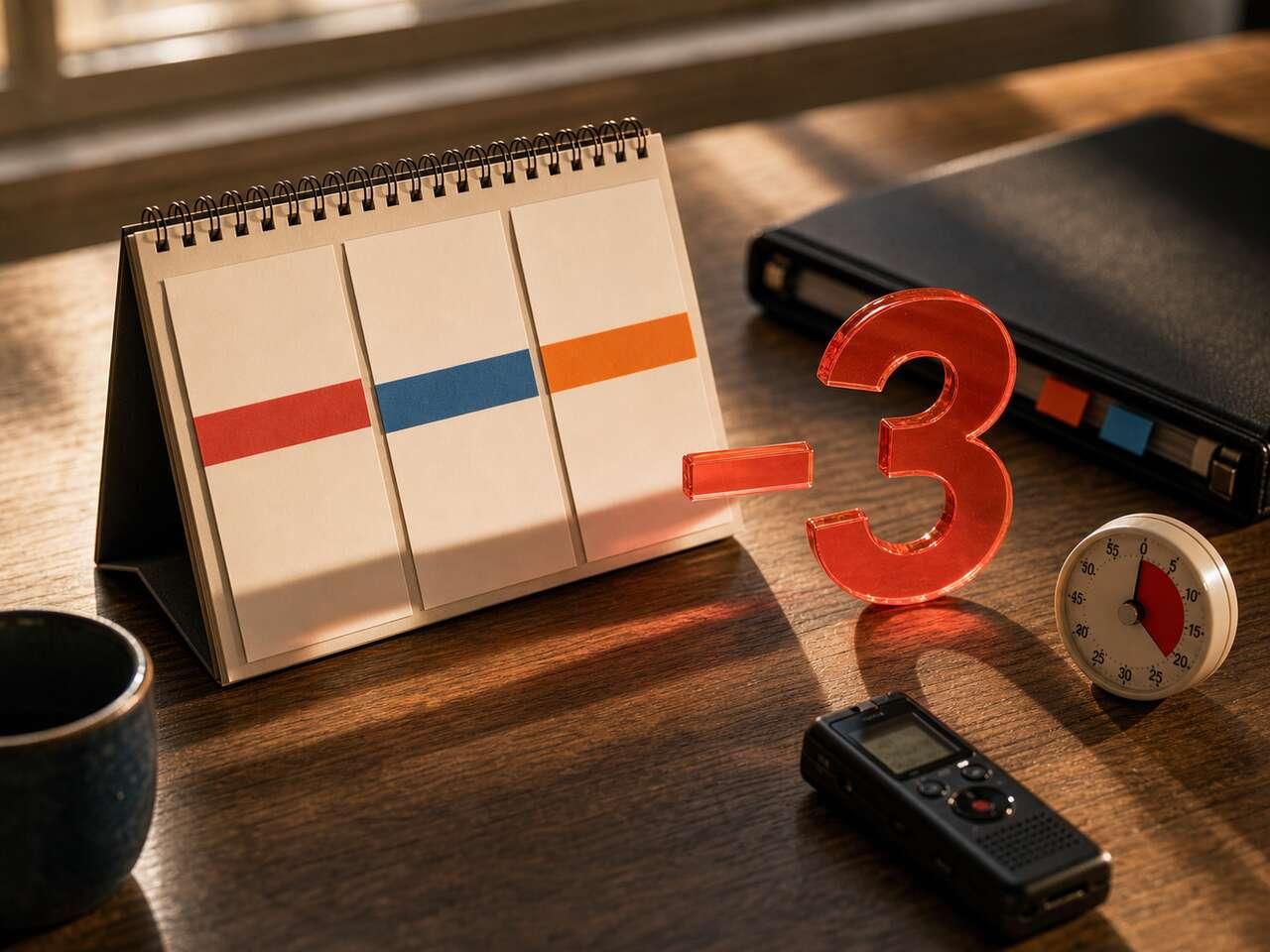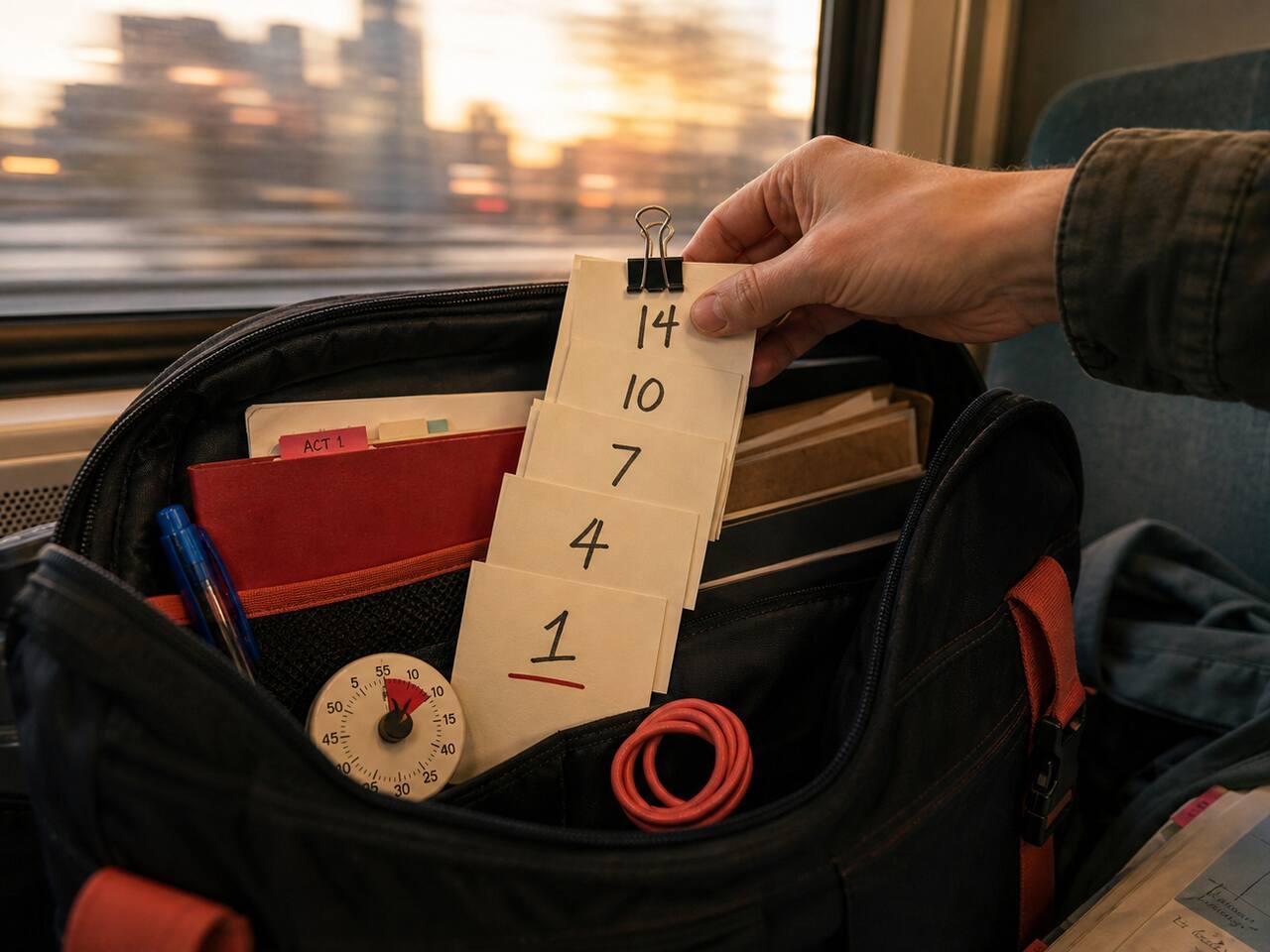
Going off-book fast doesn't mean running lines from the top every day until they stick. It means working backwards from your deadline — setting scene-by-scene gates you have to hit, not a schedule you hope to follow. Two weeks can be enough for a manageable role if you test as you go instead of waiting until the last night to find out what you don't know. This article gives you the countdown structure, the daily targets, and the test method to use at each stage.
Why the Forward Approach Fails Under Deadline Pressure
Most actors open the script on day one and start from page one. They run the whole thing, repeat the spots where they stumbled, and work their way forward until the deadline. It's intuitive, and it consistently produces the same result: solid recall in act one and fragile recall everywhere else.
The reason is straightforward. Memory builds through repetition and testing. If you always start from the top, act one gets ten rehearsals and act three gets three. By the time you're doing full runs, you know the beginning cold and the ending mostly by luck.
There's also a recovery problem. Running lines from the top builds linear memory — you know the lines in sequence, but if you lose your place, you can't find it without backing all the way up. In rehearsal, you enter cold. You pick up from whatever cue just happened. Your recall needs to work from anywhere in the scene, not just from the first line.
Working backwards from your deadline forces a different approach: every part of the script gets attention before you ever run the whole thing together. And it forces you to prioritize — the scenes you know least get the most time, not the least.
Build Your Countdown From the Deadline Back
Before you plan anything, map your script. Count the scenes where you have lines — not pages, not acts, but individual scenes. Scenes are how rehearsal is structured, and scenes are how you should track your progress.
Then divide your two weeks into three phases:
Phase 1 — First rough pass (Days 14–10) Read each of your scenes aloud with the script in front of you. Don't try to memorize yet — just anchor the structure. What comes before your first line? What cues you? What follows your last line in the scene? By day ten, nothing in the script should feel unfamiliar.
Phase 2 — Scene-by-scene off-book (Days 9–4) Split your scenes into two halves. The first half of the script gets days 9–7. The second half gets days 6–4. Each day, close the script and run only the scenes assigned for that day. If you drop, note it. Don't move to the next scene until you can run the current one cold — from any cue — at least twice without a prompt.
For example, if you have ten scenes: assign scenes one through five to days 9–7, and scenes six through ten to days 6–4. By day 7, your first five scenes should be solid enough to enter from any cue without a prompt. If they're not, you know exactly which scenes still need time — and you have three more days of focused work before full runs begin.
Phase 3 — Full runs and pressure tests (Days 3–1) Day 3: full run, script nearby if needed. Mark every drop without stopping. Day 2: full run without prompts — if you lose a line, keep going and note it after. Day 1: pressure test. Drop in from random scenes in no particular order. Ask someone to throw you a cue from anywhere in the script and respond.
This structure gives you a daily target specific enough to know whether you're on track. If you're behind at day 7, you have time to recover — you know exactly which scenes are the problem.
Test Yourself the Way Rehearsal Actually Works
The most common mistake is testing in optimal conditions: from the top, in sequence, no external pressure. That's not what rehearsal looks like.
The test that actually tells you whether you know a scene is this:
- Enter from a cue in the middle — not your first line
- Say your lines without the script visible
- Recover without looking if you drop
- Repeat from a different entry point
If you can pass this three times in a row for a scene, you know it. If you can't — even if you made it through the whole thing once cleanly — you don't know it yet.
This distinction matters most in week two. You'll have scenes that feel memorized because you've run them from the top repeatedly. But "I ran it" and "I know it from any cue" are different things. The second week is when you convert the first into the second.
Run this test with your lines hidden one at a time — a cover sheet, or a blackout view on a digital script — so you have to recall each before the next appears. Enter from a scene in act two, not from the top and not from act one, and you'll immediately see which lines are actually locked in and which ones you've only been reading past.
Track Where You Are Without Losing Study Time to Admin
The simplest tracking method is a three-column list: one row per scene, columns for solid, shaky, not there. After each session, update it. Over the course of the countdown, you're watching the "shaky" column shrink.
What you want to avoid is reaching day 3 without knowing which scenes are ready, because you've been running everything together and the blur makes every scene feel about the same. You need to know the specifics. If you find yourself making excuses — "I'll know it better after one more full run" — that usually means you haven't been testing scene by scene. You've been running and hoping.
A full breakdown of how to structure your entire off-book planning cycle — from table work through the final pressure test — is in the off-book planning hub at /blog/off-book/.
Whatever you track in, keep the granularity at the scene level, not the act level. "Act two is shaky" hides which of its four scenes is the actual problem — and the vague version is exactly the one that lets you coast to day 3 without noticing you've been avoiding one scene the whole time.
Do it in HitCue
- Blackout mode: hides your lines one at a time during scene tests, so you're testing real recall from any entry point in the scene — not just reading through the page from the top.
- Character focus view: isolates your character's lines and cues in each scene so you can drill the day's assigned scenes without scanning the full script.
- Character statistics: tracks your progress scene by scene across the countdown, so you always know what's solid and what still needs a session.
Import your script, map your deadline, and run your first scene test tonight. → Download HitCue