Classical acting technique isn't a voice. It's a set of marks you put on the page before you decide how the line sounds. You scan the verse to find where the rhythm breaks, plan the breath by thought instead of by punctuation, then mark the antitheses and operative words the argument actually turns on. Do it in that order and heightened text stops feeling ornamental. Below is the marking pass, filled in on an original verse scene, plus the three places it goes wrong in rehearsal.
Scan the Line Before You Decide What It Means
The default line is iambic pentameter: five pairs of syllables, weak then strong. Regularity is the baseline, not the discovery. Hunt for the places the line breaks the pattern — that's where the character is under pressure.
Do this pass with a pencil, one scene at a time:
- Count the syllables. Ten is the norm, and any other count is a prompt to look closer, not a verdict. Eleven often signals a feminine ending — a soft, unresolved finish — but may be an elision your edition didn't mark. Nine or fewer may be half of a shared line, a deliberate short line, or your edition's lineation. Check the stress before you name it.
- Mark inversions. A foot that lands strong-weak instead of weak-strong, often the first one, throws the stress onto a word the character couldn't wait to say.
- Mark spondees. Two strong beats side by side. The line stalls there. Treat the stall as a question — what does this cost the character here? — rather than an answer.
- Mark shared lines. Half a pentameter from you, half from your partner. Play it without a pause first, then decide with your partner whether it needs one.
- Mark elisions. Where the text compresses a word to keep the count at ten. Articulate every syllable fully and the line spills to eleven, which flattens an ending that was built to land.
One rule keeps this usable: circle only the breaks. If you mark every foot on the page, you've built a diagram you can't read at rehearsal tempo. For this pass, about a dozen marks per page is a workable starting ceiling — past that, most actors stop looking at them. Adjust it once you know what you actually read in the wings. It's a narrower job than the full breakdown covered across the script analysis hub, deliberately so.
Watch for prose too. Classical texts drop out of verse regularly, often when a character stops performing. When the metre disappears, stop scanning and read for the sentence's own rhythm. The switch itself is usually the point.
Plan the Breath by Thought, Not by Line Ending
The end of a verse line is not a breath. It's a handrail — you touch it and keep going.
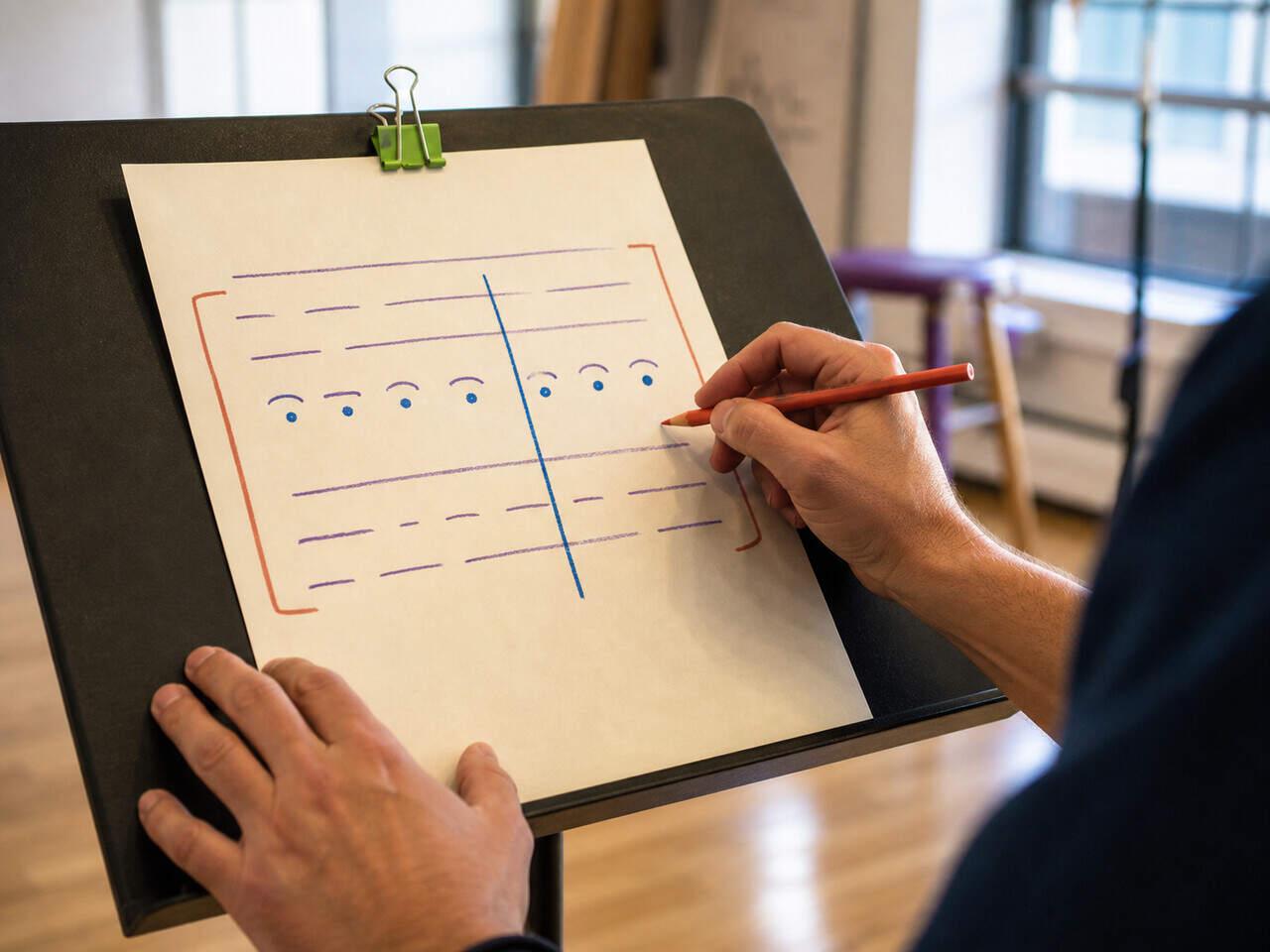
Bracket each complete thought, from capital letter to full stop, however many lines it runs across. Aim to breathe at your brackets and nowhere else. If a bracket is too long to reach on one breath, that's information: either the character is running out of control, or you need more support at the start of the thought. Sometimes the honest answer is that the thought needs an extra breath. Take it at a point you've chosen and marked, rather than letting a comma decide — and if a director or voice teacher has asked for different phrasing, theirs wins.
Here's the reversal that saves the most time. Most actors underline the important words first, then discover in week two that they can't reach the end of the thought. Mark the breath before the meaning — the meaning has to fit inside the air you've got.
Then mark the caesura — a full stop landing in the middle of a line. Draw a vertical bar through it. A mid-line stop tends to be the loudest event in the line. Test it as the turn: play the stop for real once and see whether the scene changes direction.
Mark Antithesis and Operative Words: A Filled Example
Heightened text argues in pairs. Find the pairs and the stresses are handed to you, so you don't have to invent emphasis. The discipline is one operative word per thought, not per line — stress three and you've stressed none.
Here's an original scene. Leonora has called her father's steward to her rooms after midnight.
BRAND: You sent for me at midnight, not at noon. LEONORA: At noon the house has ears. At midnight, none. BRAND: Then speak, and I will hear you as a friend, not as the man your father paid to watch. LEONORA: My father paid you. I will pay you more. Gold speaks a longer sentence than the truth. And you will take it, Brand, or you will leave me. BRAND: I have not said no. LEONORA: Nor have you said yes.
| Line | What to mark | What it changes |
|---|---|---|
| You sent for me at midnight, not at noon. | Antithesis: midnight / noon | The stress is built in. Don't add a third emphasis on "sent". |
| At noon the house has ears. At midnight, none. | Caesura after "ears"; the pair mirrored back | The mid-line stop is her turn. She returns his own antithesis reversed. |
| Then speak... / not as the man... | Enjambment — no breath after "friend" | One thought over two lines. Breathing at "friend" gives away the second half early. |
| My father paid you. I will pay you more. | Antithesis: father / I, paid / pay more; caesura after "you" | Past against future. The offer only lands if the mid-line stop is real. |
| Gold speaks a longer sentence than the truth. | Spondee on "Gold speaks" | Two strong beats stall the line. Worth testing as the line she believes least. |
| And you will take it, Brand, or you will leave me. | Feminine ending on "leave me" | Eleven syllables, soft finish. Don't press it into a full stop — it isn't resolved. |
| I have not said no. / Nor have you said yes. | Shared line — the two halves make ten | Pick the cue up inside the metre. Pause, and the line loses its shape — agree it with your partner before you add one. |
There's a practical reason the no-pause default is worth trusting. Elizabethan actors worked from parts carrying only their own lines and the words that cued them, so the shape of the verse was one of the few timing signals they shared. Whether or not that shaped the writing, the effect holds in rehearsal: pick the half-line up inside the metre and the exchange tightens.
Check your text before you mark any of this. In a scanned PDF, shared lines are often printed flush left as two short lines, and the scan turns them into two unrelated speeches. Count syllables. Two consecutive short lines from different speakers that add up to ten are probably one line — worth rejoining before you mark a pause where the lineation asks for none.
Where Classical Marking Fails in Rehearsal
Three failure modes, in the order they usually show up.
- You start singing the metre. The sign is that your partner's lines begin sounding like yours. Read the whole thought aloud once as prose, at speed, then put the verse back. The marks map where pressure lives; they are not a rhythm to perform.
- The marks belong to a text that changed. The director restores four cut lines in week three, your shared line becomes end-stopped, and the breath plan you built in week one is quietly wrong. Keep breath brackets in a different colour from meaning marks, so you can redo one pass without redoing both.
- You marked alone, and the scene is a duet. Shared lines and mirrored antithesis only pay off if the other actor takes them. Bring two or three specific marks to your partner — "this is a shared line, no pause" — not the whole page. Marks that live only in your copy are a private habit, not a technique.
Once the verse holds and the breath is planned, run beat analysis over the same scene. The metre tells you where the pressure sits. Beats tell you why it moves.
Do it in HitCue
- Line editing: correct what a scan mangled — edit the text of a broken half-line, delete the stray fragment it left behind — so you're marking the verse you'll actually speak.
- Scene notes: keep the scansion and breath decisions attached to the scene, so a week-three restored cut means editing one note instead of re-marking the page.
- Character focus view: isolate your character's verse to run the operative-word pass without the surrounding text pulling your eye.
Import the scene you're working on, use Line editing to correct any lines the scan broke, then store your breath brackets in Scene notes before the next run. → Download HitCue