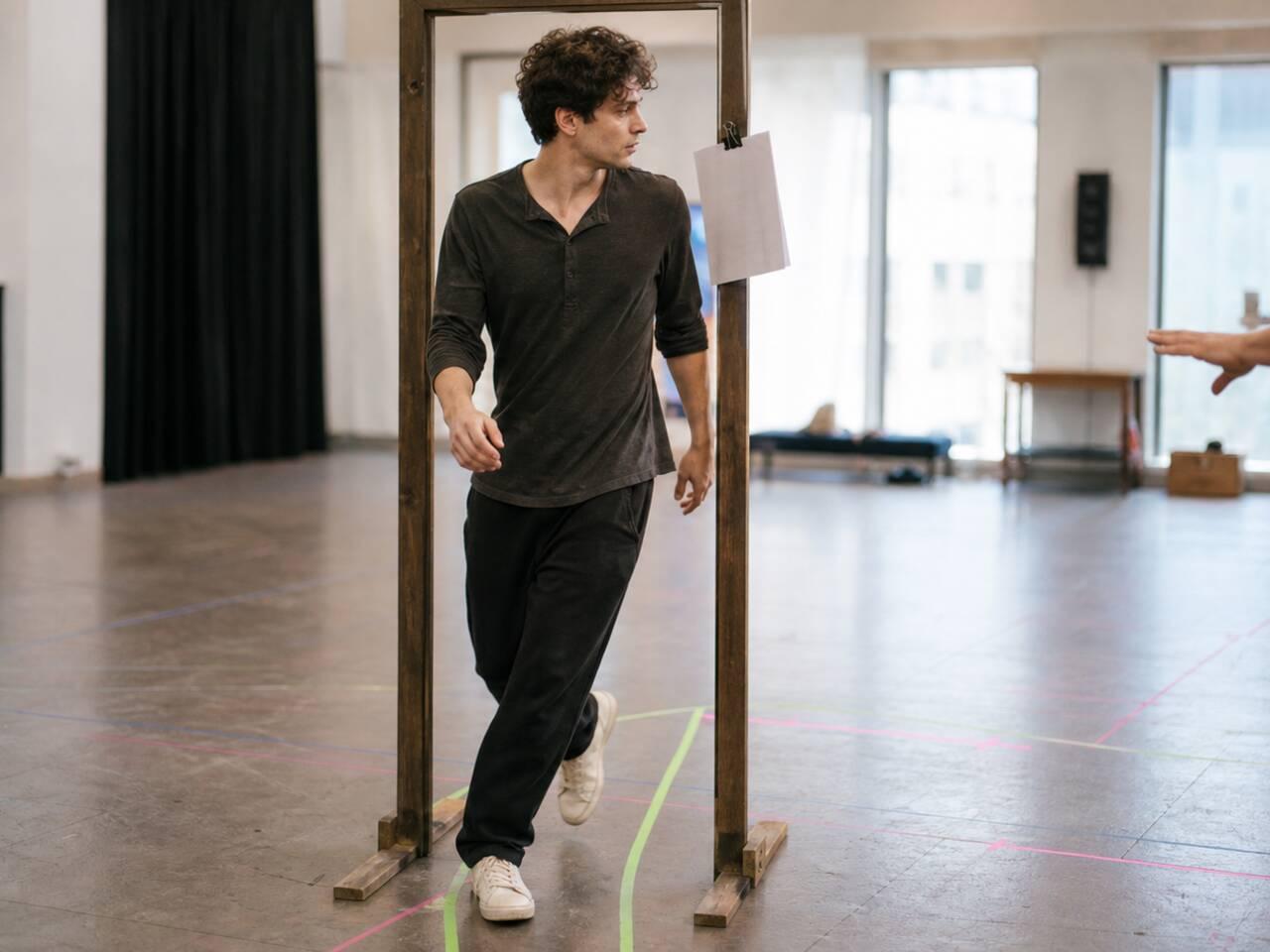
Blocking is not a note you write once. It's a record you rewrite several times before opening, so the way you write it matters more than the notation you choose. Anchor every move to the line that triggers it, keep the shorthand short enough to write while the director is still talking, and never erase an old move — cross it out and date it. Most of what you write in week one will change by week four, and some of it will change back.
Anchor the Move to the Cue Line, Not the Page Margin
The common instinct is to write blocking wherever there's white space, or to keep a separate list of moves per scene. Both fail in the room, for the same reason: on stage you don't recall a move by page number. You recall it by the line just before it.
So write the move at the height of the line that triggers it, in the left margin. If the move happens on your own line, mark it at that line. If it happens on your partner's line, mark it there — the cue is theirs, not yours.
A separate blocking list can't do this. When you drop a move in a run, you see immediately whether you missed the cue or the move, because they're on the same row. If the shorthand sits inches away from the line that fires it, you rehearse words and staging as two tracks — and they come apart the first time someone paraphrases a line.
The wider layering discipline — keeping blocking separate from character work so one can change without disturbing the other — is covered in digital script annotation.
A Blocking Shorthand You Can Write in Three Seconds
During a stumble-through, a director can hand you several moves inside one speech, each landing only a few seconds apart. Any notation longer than that is a notation you'll abandon by week two.
Use standard stage geography, written as compressed as possible:
| Mark | Means |
|---|---|
X | Cross |
US / DS | Upstage / downstage |
SL / SR | Stage left / stage right (yours, facing the house) |
XDL | Cross down left — direction letters chain onto the X |
^ | Rise |
v | Sit |
w/ | With, or following, another character |
1 2 3 | Numbered when a single speech contains more than one move |
This table assumes an end-on or proscenium stage, where US/DS means away from/toward the audience and SL/SR are yours as you face the house. Thrust and in-the-round staging don't have one audience-facing direction, so confirm the company's orientation convention with the director or stage manager before you start marking moves — the shorthand only works if everyone reads the same geography from it.
Two rules keep it fast. First, if you can't say the note out loud in under two seconds, it's too long — "XDL, v on arm" is a note; "cross down left and sit on the arm of the chair while looking at Theo" is a paragraph. Second, write the destination, not the path. In most rehearsal rooms, the path gets restaged more often than the destination — a cross moves around furniture or another actor while the underlying intention stays put — so a note about the route is usually the first thing that goes stale.
Here's an original scene, marked. Noor is at a table upstage; Theo enters with bags.
1NOOR: You left the door open again. THEO: I was carrying two bags.2NOOR: And a phone, apparently.3THEO: Put it down, Noor. It's not yours to read.
| # | Written note | Reads as | Hangs on |
|---|---|---|---|
| 1 | ^ from tbl | Rise from the table | Her own line — the move starts the scene's pressure |
| 2 | XDL → coat, take phone | Cross down left to his coat, take the phone out | Her own line, mid-sentence |
| 3 | THEO X to N, hand out — hold DL | He crosses to her, hand extended, and she stays down left | His line — the cue is his, so the mark sits on his line |
Note 3 records what he does, not what she does. That's deliberate: your copy has to tell you what's coming toward you, or your own partner will surprise you in tech. Anything you don't yet understand goes in the margin as a question — the script annotation symbols cheat sheet covers that mark.
Update Without Erasing: Keep Every Version Dated
The single most useful habit in blocking notation costs nothing: never erase. Strike the old move through with one line, tag it with the week, and write the new one underneath with the same move number plus a letter.
2   XDL -> coat, take phone          wk1
2   ---- cut wk3 (phone in his pocket now)
2b  v on table edge, wait            wk3
This is a common moment in any rehearsal process long enough to have a week four: the director watches a run and says "go back to what you were doing before." If you erased week one, nobody can reconstruct it — not you, not stage management, not your partner, who erased theirs too. Ten minutes disappear into three people half-remembering a cross.
Two more update rules worth having in place before you need them:
- When a director asks for both versions, record both. Write
2aand2bwith a slash between them and don't decide which one is real. Deciding early means writing the losing version out of your copy before the choice is actually made. - Re-mark after tech, not during. Tech changes staging for sightlines, lighting and set, and it changes it repeatedly in the same hour. Take rough notes during, then do one clean pass afterwards while it's still same-day accurate.
Where Blocking Notes Break Down
Four failure modes, roughly in the order they appear.
- The notes are unreadable at tempo. You wrote them clearly but slowly, in full sentences. The test isn't whether you can read them at the kitchen table. It's whether you can read them in the wings, in half-light, one line ahead.
- The blocking was written but never walked. A move you've only read is not a move you have. Walk each new cross once, alone, on the line that triggers it, before the next rehearsal — even in a room with no set.
- The staging fights the line. If a cross keeps landing on the same word every night and the word keeps dying, the problem is usually that the move takes the breath the thought needed. Bring it up as a question rather than fixing it privately, because the director may have staged it for a reason you can't see from inside it.
- Only your copy has the change. Blocking is agreement between at least two people. If your partner is covered by an understudy for a week, or a swing goes on with 24 hours' notice, the version that matters is the one more than one person can read. Reconcile your marks with your partner's before the next run, not after the next mistake.
Blocking notation isn't a diagram of the stage. It's a dated record of decisions that keep changing, and its job is to stay recoverable when someone asks for a version you stopped using three weeks ago. Keep it in the script annotation layer of your copy and it survives the changes.
Do it in HitCue
- Scene notes: hold the dated blocking record for each scene, so a week-one cross that gets restored in week four is still readable instead of erased.
- Scene navigation: jump straight to the scene the director just restaged and write the move while it's still exact, rather than reconstructing it after the run.
- Shared notes: reconcile your version of a cross with your partner's before the next run, so two people aren't rehearsing two different moves.
Open the scene you restaged tonight and log the move in Scene notes — cue line and week tag included — before you forget it. → Download HitCue