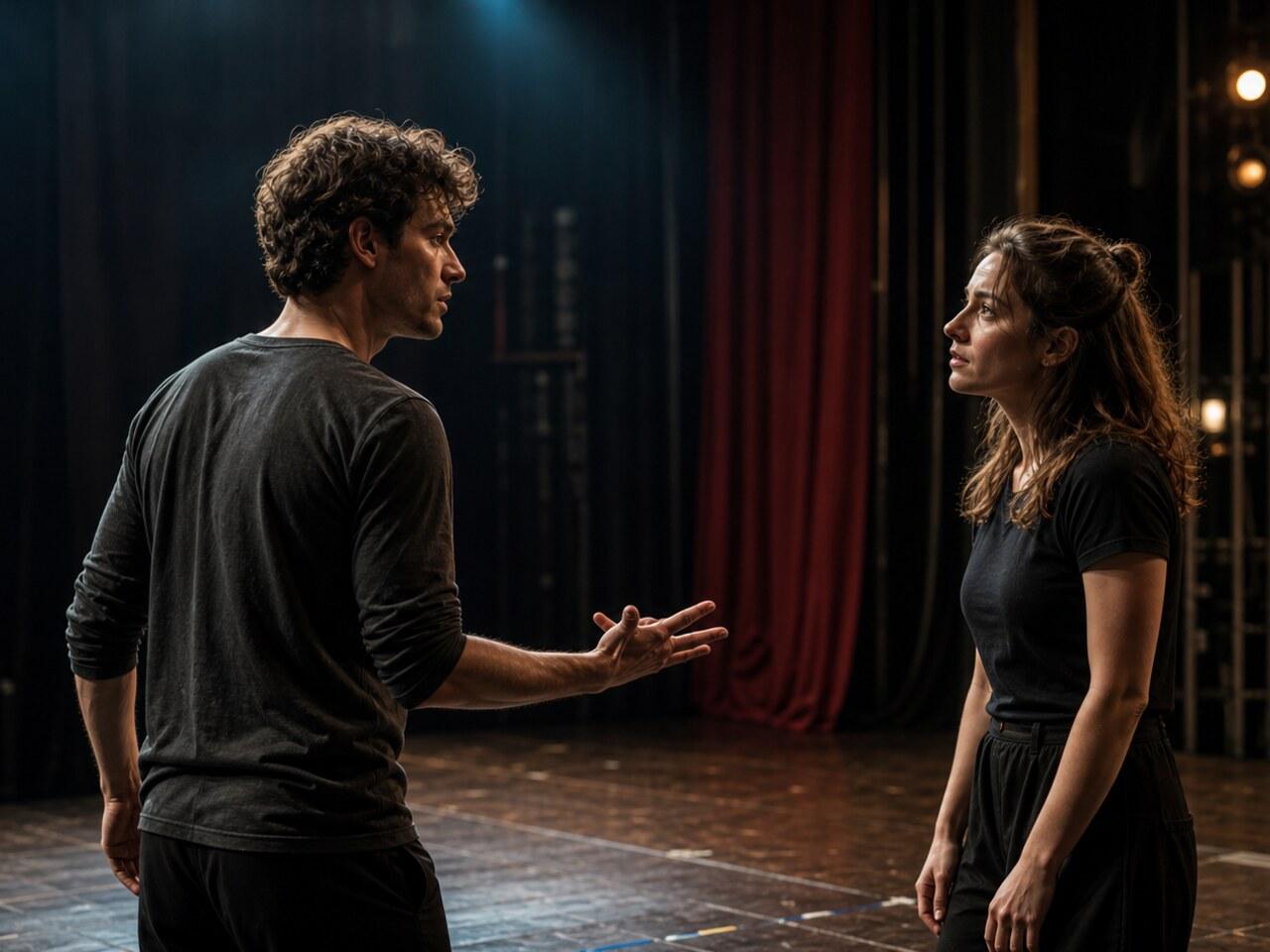
Acting techniques are structured methods for turning a script into a performance — systems for building a character, finding truthful emotion, and repeating it on cue, eight shows a week. Most of the methods on this list, especially the realist and American lineages, are indebted to one source: Konstantin Stanislavski, who built the first systematic approach to producing truthful behaviour on demand. A few — the movement and ensemble traditions near the end — grew from separate roots.
This guide covers the ten you're most likely to meet in a drama school, a rehearsal room, or an acting class, grouped from the foundational realist systems to the more specialized ensemble and movement approaches. It is a grouping, not a ranking of quality. Most working actors borrow from several, and the technique that cracks open a naturalistic two-hander is rarely the one that unlocks a Greek chorus or a devised piece.
For each method you get the same four things: what it is, who built it, how to put it on the script in front of you, and where it tends to go wrong.
The 10 acting techniques at a glance
| Technique | Key figures | Core idea | Strongest for |
|---|---|---|---|
| Stanislavski's System | Konstantin Stanislavski | Build truthful behaviour from given circumstances, objectives, and actions | Almost any realistic text; the shared foundation |
| Method Acting | Lee Strasberg | Reach real emotion through affective (emotional) memory | Deep naturalistic roles with time to prepare |
| Meisner Technique | Sanford Meisner | Stop watching yourself; react truthfully to your partner | Live, reactive scene work and listening |
| Stella Adler Technique | Stella Adler | Reach emotion through imagination and given circumstances | Big-world plays, classical and epic text |
| Uta Hagen Technique | Uta Hagen | Substitute your own specifics through structured questions | Grounded, detailed realism |
| Michael Chekhov Technique | Michael Chekhov | Find the character in the body through psychological gesture | Heightened, physical, non-naturalistic roles |
| Practical Aesthetics | Mamet & Macy / Atlantic Theater Co. | Replace feeling with a clear, playable action from the text | Actors who freeze chasing emotion |
| Classical / Verse-Based | Tradition (Copeau, Saint-Denis) | Let the text — verse, breath, structure — drive the acting | Shakespeare and heightened language |
| Viewpoints | Bogart & Landau (after Overlie) | Compose from time and space, not psychology | Ensemble, devised, physically staged work |
| Laban & Movement-Based | Movement lineages (Laban, Lecoq) | Build character and feeling from how the body moves | Physical theatre, mask, strong character bodies |
1. Stanislavski's System
What it is. The foundation of modern actor training. Stanislavski spent decades building a repeatable way to produce truthful behaviour on demand instead of waiting for inspiration. Its core tools are the given circumstances (everything true about the character's world), the objective (what the character wants in the scene), the magic if ("what would I do if I were in this situation?"), and breaking the script into units and actions — small playable steps toward the want.
On the page. Read the scene and answer one question first: what does my character want from the other person, right now? Then split the scene at each point the tactic changes, and play an action — a verb you do to your partner — rather than an emotion. This is the basis of acting objectives and tactics and beat analysis.
Where it goes wrong. It becomes a homework exercise. Actors fill pages with analysis, then never get it on its feet. The system is only worth anything once the choices are tested out loud, in the scene.
2. Method Acting
What it is. The American outgrowth of Stanislavski's early work, developed by Lee Strasberg at the Group Theatre and the Actors Studio. Its signature tool is affective memory (also called emotional memory): the actor recalls a real personal experience to summon a genuine emotion, supported by relaxation and sense memory — rebuilding a place or object through the five senses until it feels present.
On the page. Mark the moments that need a specific emotional charge. For each, find a personal memory whose residue matches — not the same event, the same feeling — and use sense memory to make the imagined room, weather, or object concrete enough to affect you.
Where it goes wrong. This is the technique with the loudest reputation and the biggest risks. Chasing your own feeling can pull focus off the scene's objective and off your partner. Dragging private pain into a long run is hard to sustain, and "staying in character" offstage is a working choice, not a virtue. Used carelessly, it produces self-absorption that stops you listening.
3. Meisner Technique
What it is. Sanford Meisner trained with Stanislavski's ideas but rejected emotional memory. His definition of acting is "living truthfully under imaginary circumstances." The famous tool is the repetition exercise: two actors repeat an observation back and forth until the words stop mattering and real, moment-to-moment reaction takes over. Emotion is prepared before an entrance, then the scene is played by responding to what the partner actually gives.
On the page. Learn your lines flat — no fixed inflections, no rehearsed readings. The reading is supposed to arrive from your partner in the moment, not from a decision you made alone at your desk. Drop the plan and take your attention off yourself.
Where it goes wrong. It needs a present, responsive partner, which makes it hard to drill alone the night before. And repetition can curdle into a mechanical tennis match if the truth drains out of it.
4. Stella Adler Technique
What it is. Adler studied directly with Stanislavski in Paris and came back convinced that Strasberg had it wrong. Her answer was imagination over personal trauma: the actor builds the character's world so vividly that the given circumstances themselves produce the feeling. Her watchwords — "your talent is in your choice" and "don't be boring" — push actors toward bigger, braver, more fully imagined choices.
On the page. Research and build the world of the play until you can see it. Where the Method actor reaches inward for a memory, you reach outward into the character's circumstances and let imagination supply the emotion. Make the choice that is most alive, not most comfortable.
Where it goes wrong. Without rigorous grounding in the text, big imaginative choices float free of the actual scene. Bold is only useful when it is bold about what the play is doing.
5. Uta Hagen Technique
What it is. A practical realism set out in Hagen's books Respect for Acting and A Challenge for the Actor. Her tools include a checklist of questions — Who am I? What time is it? Where am I? What surrounds me? What do I want? What's in my way? What do I do to get it? — plus substitution (transference), where you swap a specific person, place, or object from your own life for the equivalent in the play.
On the page. Answer her questions for your character in this scene, in specifics, not generalities. Then replace any vague stage relationship — "my estranged father" — with a precise, real equivalent of your own, so the stakes stop being abstract. Pairs well with a solid character breakdown.
Where it goes wrong. Substitution misfires when the parallel is loose. If your real reference doesn't truly match the character's, it drags your attention onto your own life and out of the scene.
6. Michael Chekhov Technique
What it is. Chekhov was Stanislavski's student and called his most brilliant. His approach is psycho-physical — it reaches the inner life through the body and the imagination rather than personal memory. The central tool is the psychological gesture: a single full-body movement that captures the character's deepest want. He also works with an imaginary body, an imaginary centre, and atmosphere.
On the page. Find one gesture that expresses what your character wants — a reach, a grip, a recoil — and rehearse it full-out and physical. Then shrink it down inside you until it's invisible but still colours how you stand and speak. Try moving your imaginary centre out of your chest and see how the character changes.
Where it goes wrong. It is abstract, and hard to crack without a teacher. Done from the outside, the gesture looks indicated — a mime of a feeling rather than the feeling itself.
7. Practical Aesthetics
What it is. A lean, analytical technique conceived by David Mamet and William H. Macy and developed at the Atlantic Theater Company and its acting school. Its method is laid out in A Practical Handbook for the Actor, written by members of the Atlantic. You break a scene into four steps: the literal (what is physically happening), the want (what your character wants the other to do), the essential action (a universal, playable action phrased as "to —"), and the as-if (a personal analogy that makes the action matter). It deliberately leaves emotion alone: play the action, and feeling takes care of itself.
On the page. Reduce your whole scene to one essential action — "to get a friend to admit they're wrong," "to make someone choose me" — and then simply do it, fully, toward your partner. Stop managing your emotional state.
Where it goes wrong. To actors who need imaginative or emotional warmth, it can feel cold and mechanical. By design it ignores the inner preparation that other techniques treat as essential.
8. Classical / Verse-Based Acting
What it is. Less a single authored method than a training tradition — the text-led approach that runs through Jacques Copeau and Michel Saint-Denis into schools like RADA and LAMDA. Rather than starting from psychology, it starts from the language: voice, breath, scansion, antithesis, status, and the structure of heightened text. The premise is that a well-written speech already tells you how to act it — your job is to speak it so the thought lands.
On the page. Scan the verse and mark the rhythm. Breathe at the line endings, not in the middle of thoughts. Find the antitheses (the words set against each other) and the operative words that carry the argument, and let the structure shape how the thought builds. This is the toolkit for Shakespeare and any heightened language.
Where it goes wrong. Technique can take over. Push it too far and you get beautiful, immaculate speaking with no impulse underneath — sound without a person.
9. Viewpoints
What it is. A technique for composing performance out of time and space rather than psychology, developed by Anne Bogart and Tina Landau from Mary Overlie's Six Viewpoints. You work with elements like tempo, duration, kinesthetic response, repetition, spatial relationship, shape, and gesture. It is built for ensemble and devised work, where meaning is generated physically by a group rather than decided privately by an individual.
On the page. When psychology stalls and the scene feels stuck in the head, change the staging instead: alter the tempo, shift the spatial relationship to your partner, introduce a repetition. Let the physical choice generate the meaning, then notice what it makes you feel.
Where it goes wrong. It is an ensemble and composition tool. On its own it will not deliver a naturalistic, text-driven scene — it needs to sit alongside the more psychological techniques, not replace them.
10. Laban & Movement-Based Work
What it is. A family of body-first approaches. Rudolf Laban analysed movement into Efforts — combinations of weight, space, time, and flow that produce qualities like press, flick, glide, and punch. Jacques Lecoq's school built physical storytelling, the neutral mask, and clown into a full training. The shared idea: how a character moves tells you, and the audience, who they are.
On the page. Find the character's effort quality — are they a presser or a flicker? — and where their movement centres. Build the role from the body inward and let the physical life feed the text, rather than bolting movement on at the end.
Where it goes wrong. Physical vocabulary without intention reads as choreography, not character. The body work has to stay tied to what the character wants, or it becomes decoration.
Other approaches worth knowing
These come up often enough that you should recognize them, even if they sit outside the core ten:
- Brechtian / Epic Theatre (Bertolt Brecht) — the actor presents the character rather than disappearing into them, using gestus and the alienation effect to keep the audience thinking. Built for political and presentational staging.
- Theatre Games (Viola Spolin) — structured improvisation that builds presence, spontaneity, and ensemble. The root of much of the warm-up and devising work you'll meet in a rehearsal room.
- Suzuki Method (Tadashi Suzuki) — a rigorous, grounded physical training focused on stamina, the feet, and the lower body. A conditioning discipline more than a scene-analysis tool.
- Chubbuck Technique (Ivana Chubbuck) — a contemporary, goal-driven evolution of the Method that uses the character's objective to drive through emotion toward a want. Popular for screen work.
Which technique should you use?
You don't pick one for life. Most of the realist approaches here share Stanislavski's spine — objective, given circumstances, action — so learn those fundamentals first; they make most of the others easier to absorb.
After that, choose by the text in front of you, not by personality. A naturalistic modern two-hander rewards Meisner and Hagen. Shakespeare rewards classical and verse work. A devised or choral piece rewards Viewpoints and Laban. A role you're struggling to feel anything in might unlock the moment you stop chasing emotion and play a Practical Aesthetics action instead.
Most working actors carry two or three of these and switch by job. The goal isn't to belong to a school. It's to have enough tools that, when one approach stops working on a scene, you have another to reach for.
Related reading
- Script Analysis for Actors — turn any of these techniques into concrete decisions on the page
- Acting Objectives and Tactics — the Stanislavski core that underpins most of this list
- Beat Analysis in Acting — mark where the scene turns
- Scene Study Checklist — what to decide before you walk into class
How to start
Pick the technique that fits the scene on your desk and try one of its tools on a single beat tonight — one action, one substitution, one gesture, one change of tempo. Techniques only become yours once they've survived contact with a real script and a real rehearsal, so test them small and keep what works.