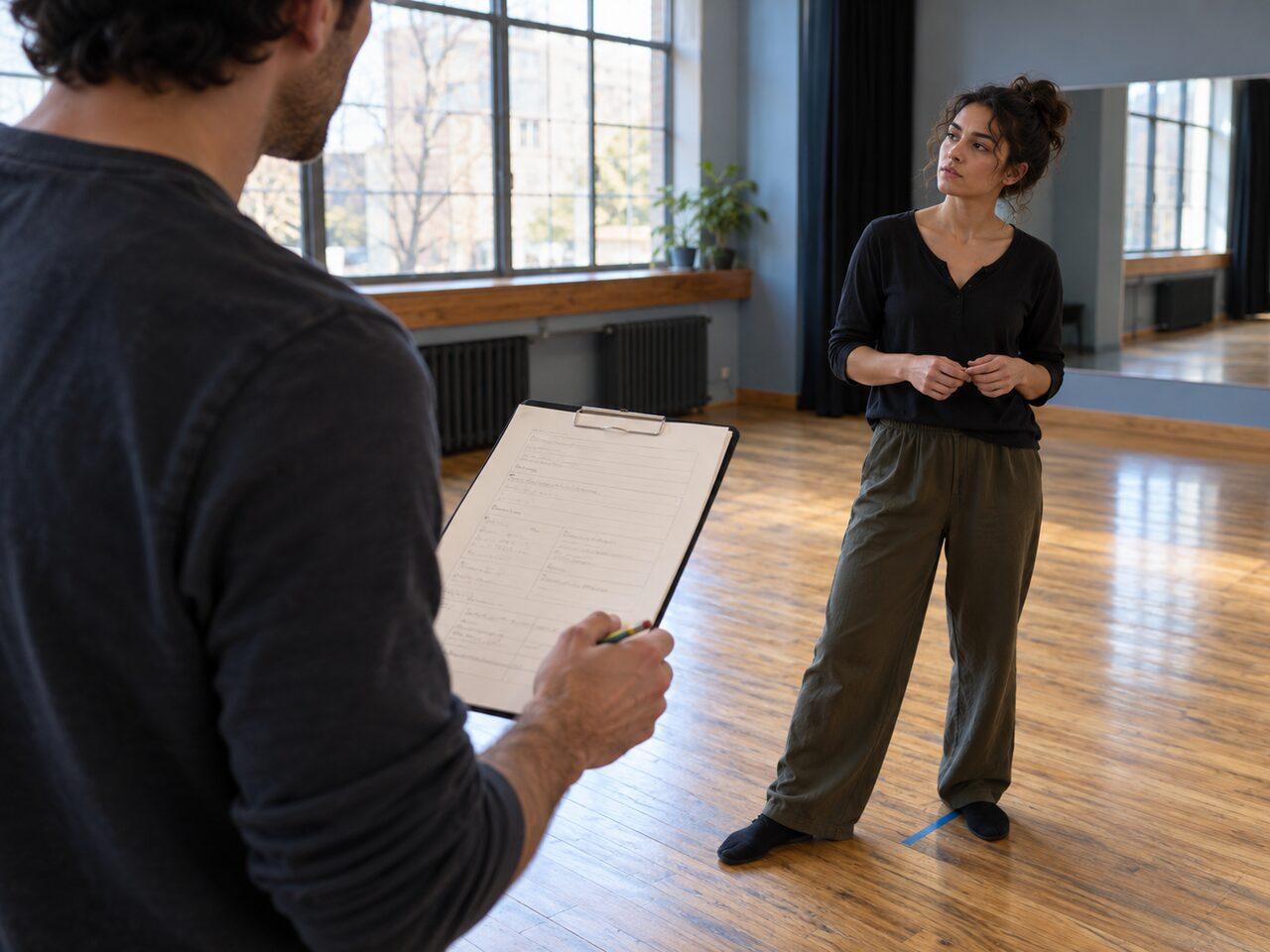
A scene study worksheet keeps one assigned scene in one place: what you want, where the scene turns, what you agreed with your partner, where your lines dropped and what you tried, and what your teacher said. Download the printable worksheet (PDF) — two A4 pages, one worksheet per scene — and fill it in pencil. The method behind each decision is in how to prepare for scene study; this page is the form you keep.
The blank worksheet
Fill one per scene, and treat every answer as a choice you can revise in rehearsal. Parts 1 and 2 can take about ten minutes as a first pass; a long scene may take longer.
Part 1 — The scene. Fill this before you contact your partner.
| Field | Prompt | Your answer |
|---|---|---|
| Play, scene, character | ||
| Partner and their character | ||
| Time limit and class date | ||
| The scene in one sentence | "At the start ... By the end ..." | |
| Text you both work from | The edition or file, and the cuts |
Part 2 — Four decisions. Write each as something you do to your partner, not a feeling you have.
| Decision | Prompt | Your answer |
|---|---|---|
| Objective | "I want my partner to ..." — something they can refuse | |
| Obstacle | "I cannot simply ask because ..." | |
| Opening action | What you are doing before your first word | |
| Opening tactic | How you try first, and what you switch to if it fails |
Part 3 — Beat map. A beat is a stretch of the scene where something changes. Note what starts each one: your partner's last words if that is your cue, otherwise an action, a silence, or the opening circumstance. Page numbers move with cuts and reprints, and cue words usually stay, unless a cut removes them, so recheck after every cut. In the last column, mark your own lines in that beat: Cold (you can say them with no page), Shaky (right meaning, wrong words) or Call (you will ask for the line).
| # | Starts on | What I do to my partner | What I expect back | What changes | Lines |
|---|---|---|---|---|---|
| 1 | |||||
| 2 | |||||
| 3 | |||||
| 4 | |||||
| 5 |
Part 4 — Agreed with your partner. Both of you copy these answers onto your own page.
| Agreed | Your answer |
|---|---|
| Cuts, marked the same in both scripts | |
| Props, and who brings each one | |
| Starting positions and what each of you is doing | |
| Crosses or physical contact | |
| Rehearsals booked, with dates |
Part 5 — Drop log. After a run, log the one to three drops you most want to fix. A run with no drops gets one row marked clean. Name a suspected cause, or more than one: W words, D a decision you have not made, P your partner or the staging, N nerves. Then write one thing to try, and after the next run record the result: closed, still dropping, or changed.
| Run | Where (cue or moment) | What I said or did instead | Suspected cause | Try next | Retest result |
|---|---|---|---|---|---|
Part 6 — Class. Write the question before class. After class, write the note and what you will try next. Fill the last row after the next showing.
| Field | Your answer |
|---|---|
| One question I want the teacher to watch for | |
| The note I was given | |
| Which beat it applies to | |
| What I will try at the next rehearsal | |
| What happened at the next showing |
A worked example: one scene, filled in
(Original scene, written for this worksheet.)
The setup: Tomas has come to his old bandmate Ines's flat to collect his drum kit, which she has stored for three years. Ines sold it in April to cover rent. You are playing Tomas. Class is Thursday, five minutes.
| Decision | Tomas |
|---|---|
| Scene in one sentence | He arrives to collect his kit and leaves with an envelope of cash and no kit |
| Objective | Get Ines to hand over the kit without letting her see it is the last thing he owns |
| Obstacle | Asking straight would show how much he needs it, and it is already gone |
| Opening action | Stands in the doorway with the van keys in his hand, not taking off his coat |
| Opening tactic | Casual — he was passing. Switches to a direct question if she stalls |
Beat 1 has no spoken cue, so it starts on the opening circumstance. The others start on Ines's words.
| # | Starts on | What I do to her | What I expect back | What changes | Lines |
|---|---|---|---|---|---|
| 1 | The opening: I am in the doorway, she is pouring tea | Stay on my feet and keep it light: I was passing | She fills the silence with small talk | I see she is stalling, not hosting | Cold |
| 2 | "It's in the box room, behind the bikes." | Walk to the door as if it is settled | She steps into the doorway | Polite stops working | Shaky |
| 3 | "There's nothing in there you need." | Drop the casual tone and ask where it is | She tells me | She says it: sold in April | Call |
| 4 | "I sold it in April." | Take the pressure off so she can pay me without being asked | She offers the envelope | I take it and leave the key on the table | Cold |
| Agreed | Tomas and Ines |
|---|---|
| Props | Two mugs, the teapot and the envelope — Ines brings them. Tomas brings his van keys |
| Starting positions | Added after run 2: Tomas in the doorway, coat on. Ines at the table with the teapot |
Beat 3 opens like this. Ines: "There's nothing in there you need." Tomas: "You don't know what I need. Where is it?" Here is the log after four runs.
| Run | Where (cue or moment) | What I said or did instead | Suspected cause | Try next | Retest result |
|---|---|---|---|---|---|
| 1, alone, cue words only | "There's nothing in there you need." | Said only "Where is it?" and skipped "You don't know what I need." | D — I may not have decided why I stop being casual here | Decide the switch on her last word, then say the skipped sentence | Run 2: sentence kept. Closed |
| 2, with Ines | "Sit. I've made tea." | Sat down | P — we had not agreed where I start | Agree positions and write them in Part 4 | Run 3: stayed in the doorway. Closed |
| 3, with Ines | "I sold it in April." | Answered a beat late | N, maybe — I knew the teacher would watch this moment | Run the scene twice in a row without stopping | Run 4: still late. Open |
| Class | Tomas |
|---|---|
| Question | Does the switch from casual to direct land before I speak? |
| Note given | The decision arrives on the line, not before it |
| Beat | 3 |
| Try next | Stop moving on her last word, before I open my mouth |
| Next showing | Fill in after the next showing |
Rows 1 and 2 look like memory slips, but the log points somewhere else first: a missing decision and an unagreed start. A retest shows whether the change helped, not whether the suspected cause was right, so keep the cause provisional.
When to fill in each part
- Before you contact your partner. Parts 1 and 2, and the "Starts on" column of Part 3. Send your partner the beat map and ask which turns they see. If you disagree on where a beat starts, you have found something to settle early.
- At the first rehearsal. Part 4, before you run anything. Then write "What I expect back" and keep it as written: the scene often lives in the gap between what you expected and what your partner gives you, and rewriting the column afterwards loses that gap.
- After each run. The drop log, ideally the same day, while you remember what happened.
- Before class. Your question. Keep it small: "Does my opening read before I speak?" tends to get a note you can use; "How was it?" tends not to.
- After class. The note and what you will try next, while you remember the exact words. The last row of Part 6 waits for the next showing.
Two checks keep the page useful:
- Check the beat map for sameness. If several rows say the same verb, ask what changes between them. It may be one beat, or the change may be in your partner's response rather than in your action.
- Treat causes as hypotheses. If the same suspected cause keeps coming back, try changing the cause — decide, agree, simplify — rather than only repeating the line. Record whether the change helped, and keep the cause provisional.
Before you go up in class
Go through these five answers before your scene starts. If one is a no, you can tell your teacher at the top of the scene.
- Parts 1 to 3 are filled in, and each beat says what changes
- Part 4 matches your partner's page
- Every drop you logged is closed by a retest, or you know which ones are still open
- You can say your first line with no page in your hand
- Part 6 has your question written down
If you teach a scene study class, you can hand out the PDF with the assignment and ask for Parts 1 to 3 at the first showing and Part 6 at the second. The beat map shows what the student decided, which a performance alone does not. The Drama School & Conservatory Study Systems hub covers the wider set of rehearsal methods.
Related reading
- Scene Study Checklist — what to settle before class
- How to Prepare for Scene Study — the method behind Parts 1 and 2
- Off-Book for Acting Class — how to schedule and test the lines Part 3 marks as shaky
How to start
Fill in Part 1 and the "Starts on" column of Part 3 tonight, and send the beat map to your partner before you book the first rehearsal.