The first-letter method means rewriting your lines as a string of first letters — one letter per word — and using that string to prompt full recall. "I never asked you to wait" becomes "I n a y t w." You read the letters, say the line, then check. It's a retrieval test, not a learning tool. It works once you roughly know the text and need to prove you can produce it without the page. Use it too early and you'll just stare at letters that mean nothing.
What the First-Letter Method Actually Does
The method exploits a simple fact about memory: recognising text is easy, producing it cold is hard. Reading your lines over and over feels like progress because you recognise every word. But recognition isn't recall, and rehearsal asks for recall. The first letter of each word gives you the smallest possible prompt — enough to confirm you have the line, not enough to read it.
That's the whole point. The operating rule to keep in mind: the first-letter method tests memory, it doesn't build it. If you can't already speak a line after a few attempts with the letters in front of you, the problem isn't the prompt. The line isn't learned yet, and no amount of staring at initials will fix that. Go back to working the text — connect it to intention, blocking, and the cue that triggers it — then come back to the letters to verify.
This is why the method belongs late in your off-book process, after you've done the slower work of understanding why each line follows the last.
How to Build a First-Letter Sheet
Build the sheet by hand. The act of reducing each line to its initials is itself a recall pass — typing it or generating it automatically skips the useful part.
- Take one scene at a time. Don't reduce the whole role at once. Work the scene you're drilling this week.
- Write the first letter of every word, including small words. "And then I left" becomes "A t I l." Keep articles and pronouns — they carry the rhythm of the line.
- Mark punctuation that changes delivery. Keep question marks, dashes, and full stops. They tell you where a thought turns.
- Add your cue in full above each speech. The letters test your line; the cue tests whether you can start it on the trigger, not from the top of the page.
- Leave your stage directions in plain words. A "(crosses to window)" isn't text to recall — it's context you need to see.
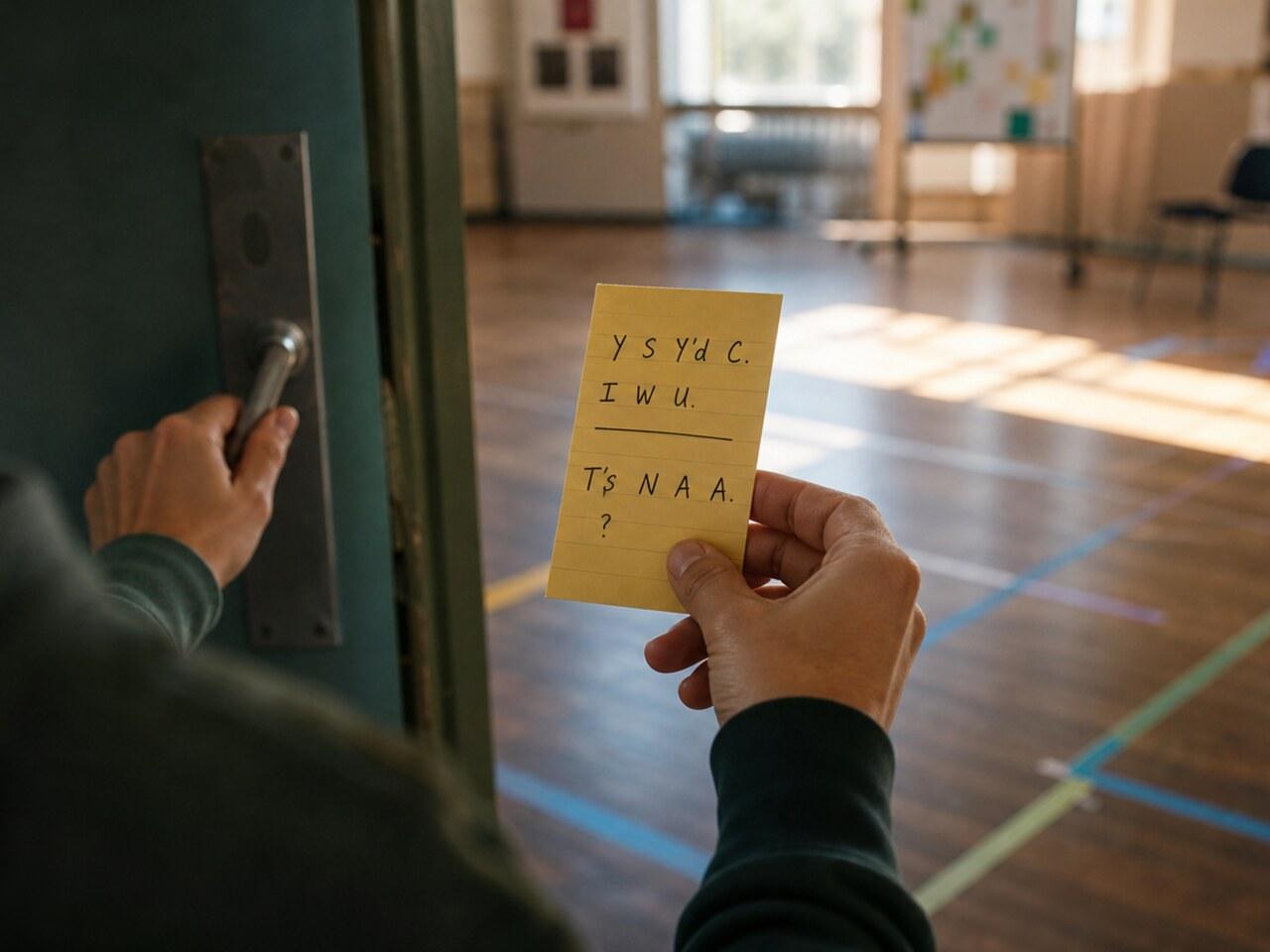
Here's a filled example from an original scene. The full text:
MARA: You said you'd call. I waited up. JOEL: I lost track of the time. MARA: That's not an apology.
The first-letter sheet for Mara's lines:
| Cue (full) | Your line (first letters) |
|---|---|
| (scene opens) | Y s y'd c. I w u. |
| "…lost track of the time." | T's n a a. |
Notice the cue stays whole and your line collapses to initials. You're not testing whether you can read — you're testing whether Joel's "…lost track of the time" pulls "That's not an apology" out of you without the words on the page.
When It Works — and When It Backfires
The first-letter method is narrow. It's excellent at one job and useless at three others. Knowing the difference saves you from drilling the wrong thing the week before opening.
It works when:
- You roughly know the lines and need a portable self-test you can run on a train or backstage.
- You keep dropping a specific word or phrase and want to isolate exactly where the line breaks.
- You're verifying retention after a few days away from a scene.
It backfires when:
- You use it as a first-pass learning method. Initials can't teach you a line you've never understood. This is the most common misuse, and it's why some actors decide the method "doesn't work." It was never meant to. For building lines you don't yet know, an approach that connects text to meaning is far more reliable — see the /memorization/ hub for systems that do that, and the guide on how to learn lines without rote memorization for the underlying thought-chain work.
- You rely on it for entrances. A first-letter sheet tests the words of your line, not the trigger that starts it. If you blank on your cue in rehearsal, the letters won't help — you need cue-line drilling instead, the kind covered in the cue lines acting guide.
- The lines are long speeches. Reducing a thirty-line monologue to initials produces a wall of letters that's harder to parse than the text itself. For long speeches, mark internal beats and build a thought-chain between them; use first letters only on the few transitions you keep losing.
There's also a quieter failure mode worth naming. If you can recite the letters fluently but freeze the moment the sheet is gone, you've memorised the pattern of initials, not the lines. Test yourself with the sheet face-down and the cue spoken aloud. If the line still arrives, you're off-book. If it only arrives with the letters visible, you've been testing the prompt, not the text.
Used in its lane — a fast, late-stage retrieval check for lines you already understand — the first-letter method does its one job well. Just don't ask it to do the learning for you.
Do it in HitCue
- Blackout mode: set it to Initials only to see just the first letter of each word, with the rest of the line hidden — the same retrieval test as a first-letter sheet, but built from your real script and revealed on tap when you need to check.
- Dialogue recordings: record your cue and line once, then play back just the cue — the same retrieval check as a first-letter sheet, but run by ear instead of by initials.
- Character focus view: isolates your character's lines and cues, so the retrieval test you build covers only what you actually have to produce on stage.
Import your script, switch on Character focus view, set Blackout mode to Initials only, and run the first-letter test on this week's scene tonight. → Download HitCue