The Michael Chekhov technique reaches your character's inner life through the body. Its main tool, the psychological gesture, turns what your character wants into one whole-body movement: a pull, a push, a throw. You rehearse it full-out, then shrink it until nobody can see it, while the impulse keeps shaping how you sit, listen, and speak.
It turns into indicating when the gesture shows a feeling instead of doing something to someone. Below: how to choose a gesture that plays, seven steps to build one, a filled example on an original scene, and the tells that it's leaking.
What Makes a Psychological Gesture Playable
Michael Chekhov trained under Stanislavski at the Moscow Art Theatre, then built a psycho-physical approach: the body and the imagination lead, not personal memory. That one piece of history changes how you prepare: you don't dig through your past at the table, you get on your feet early, before the analysis hardens into a fixed reading. The acting techniques overview shows where Chekhov sits among the other methods.
Chekhov wanted gestures that were simple, archetypal, and done with the whole body. A working set of verbs: push, pull, lift, throw, tear, wring, embrace, open, close, gather, penetrate, smash. Every one of them has a direction and a target.
For this exercise, look for a gesture that activates the character's want rather than merely illustrating a feeling. Clutching your chest or covering your face is not automatically indicating; ask whether the movement supports the action or substitutes for it.
| The feeling you're tempted to show | Possible illustrative habit | Playable gesture |
|---|---|---|
| Longing | Arms out, pleading face | To pull, slowly, like hauling in a rope |
| Hurt | Hand pressed to the chest | To push, hard, away from you |
| Shame | Hands over the face | To close, tightly, like shutting a door |
| Suspicion | Narrowed eyes, leaning back | To penetrate, carefully, through their guard |
The quick test: aim the gesture at something in the room, a door, a chair, a person. If it has nowhere to go, it probably won't help you pursue the want.
Then add one quality. The verb carries the want; the quality is how this character goes after it. Pulling slowly and pulling greedily come from two different people with the same need.
How to Build a Psychological Gesture for Your Scene
This drill adapts psychological gesture to one scene. Its sequence and limits are starting points, not fixed rules of Chekhov's technique. You need about twenty minutes and enough space to reach out with both arms. Do the full-size work at home or in an empty studio, not in front of the cast.
- Write the want as a demand on your partner. "I want you to ___." If you already have a scene objective, use it; acting objectives and tactics covers the phrasing. The gesture translates the objective. It doesn't replace it.
- Pick one verb from the set. Ask which movement would get your partner to do it if words didn't exist. Choose the simplest. If you need two verbs, you're probably looking at two beats.
- Add one quality. One adverb or a tempo: slowly, sharply, carefully, greedily.
- Do it full-out with the whole body, without straining. Start from stillness, travel through the movement, and end in a clear final shape. Hold it for a breath. Repeat three to five times. Legs, spine, and eyes take part, not just the arms. If your neck and jaw tighten, you're forcing it.
- Speak your first line out of the held shape. Then speak it during the gesture. If the line comes out exactly as it did before, change the quality. If it still doesn't change, change the verb.
- Shrink it in stages. Full body, half size, one hand, then only in your imagination while you stand still. Say the line after each size. When the line loses what the full version gave it, go back one size and repeat. You take the inner version into rehearsal.
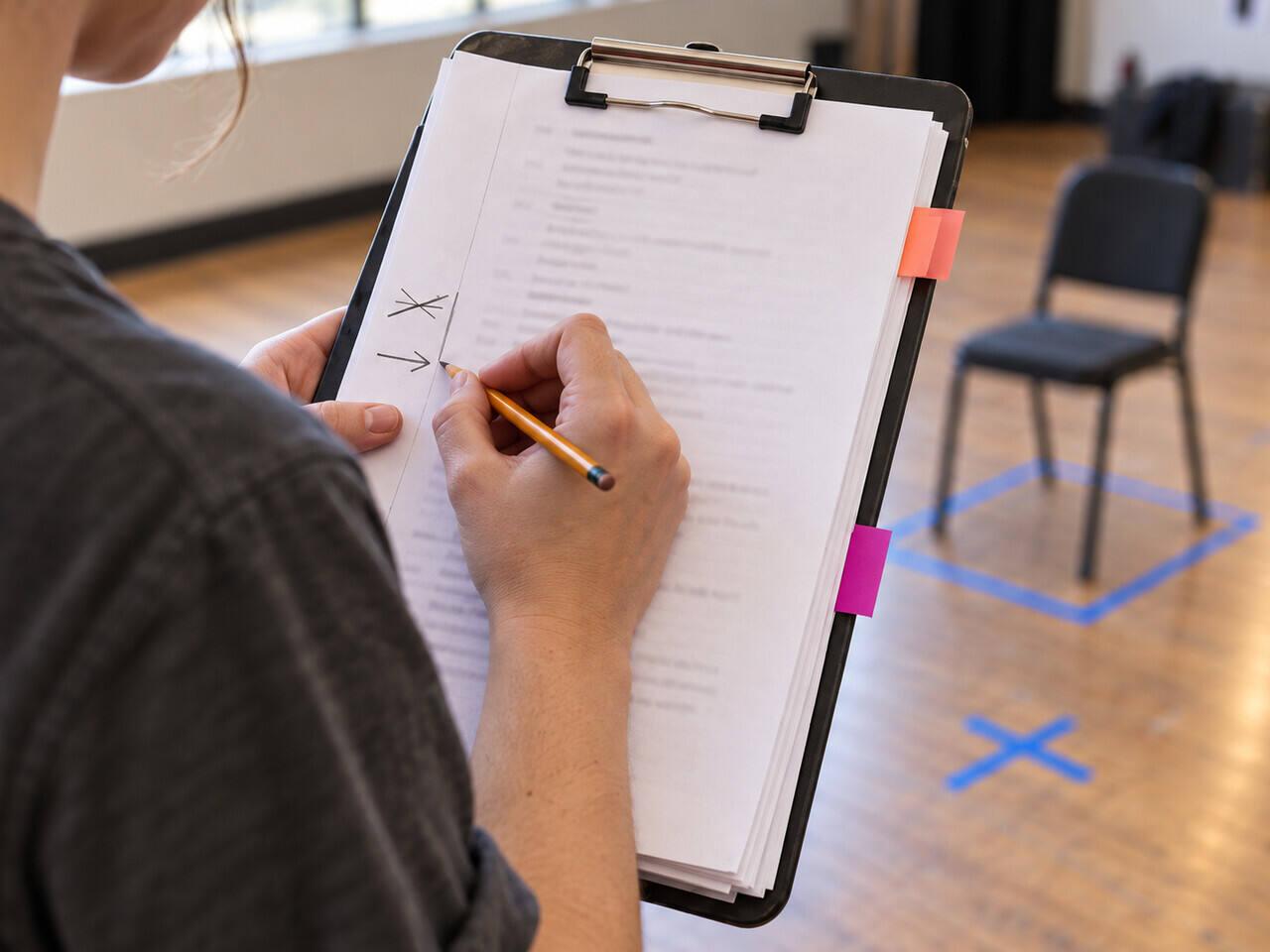
- Mark what triggers the shift. If your partner's line changes your character's action, mark the shift beside that cue. A thought, silence, or physical event may also trigger it. Test the timing in the scene rather than assuming every change belongs on someone else's line.
Start with one gesture and add another only where the scene needs a different action. Two or three may be enough for this exercise; let the scene determine the number. Your beat analysis shows where the action changes.
A Filled Example: Two Gestures on One Bench
Hana and Wes are on a station platform at 6 a.m. Wes is leaving for a job in another city. The director has them seated on a bench for the whole scene.
That constraint is where the gesture earns its place. Hana can't move toward Wes or away from him, so her want has to come out in how she sits, listens, and speaks.
| Character | Line |
|---|---|
| WES | That's the last call. |
| HANA | That's the second. They always do three. |
| WES | You looked it up. |
| HANA | I take this train every day, Wes. |
| WES | Not this one. |
| HANA | Your coffee's still full. Sit till it's cold. |
| WES | I gave notice on the flat yesterday. |
| HANA | Then you'd better run. |
| WES | Hana. |
| HANA | Go on. Doors. |
Hana's want for the first half: "I want you to miss this train." Once she hears he's given up the flat, it flips: "I want you to go before I break." Her gesture map:
| Trigger | Gesture and quality | Size in the run | Possible effect to test | Margin mark |
|---|---|---|---|---|
| Top of scene | To pull, slowly, like reeling in a line | Inner only | She may stay back on the bench and make Wes lean in to hear her | PULL / slow above her first line |
| WES: "I gave notice on the flat yesterday." | To push, quick and clean | Inner only | Her lines may become shorter and harder | → PUSH / quick beside Wes's line |
| WES: "Hana." | The push, held at its end shape | Inner only | Her eyes may go to the train doors | None. The push is still running |
In this interpretation, Wes's announcement triggers Hana's shift from pulling to pushing. Mark it beside "notice," then test whether that timing serves the exchange.
The fourth column suggests possibilities, not observed results or movements to copy. Keep any agreed blocking while allowing your response to your partner to remain live.
Where the Psychological Gesture Turns Into Indicating
The gesture describes a state. The tell: your verb is "to grieve" or "to despair." Go back to the table and choose a verb with a target.
The gesture leaks. The tell: your hand drifts toward the gesture on the same line every night, or the director says you're telegraphing. Repeating a movement the blocking asks for isn't enough to diagnose a leak; check whether you're still responding to your partner while you do it.
A common cause is jumping from full size to inner and keeping the muscle instead of the impulse. Go back to full size at home and come down through every stage again. Shrink the size, never the direction.
You play the gesture at your partner instead of with them. The tell: your reading is the same whatever your partner gives you, which means the gesture has become a fixed line reading. Let the quality respond to your partner: if Wes says "notice" gently one night, the push can arrive gentler. If the character's action changes, reconsider the gesture too.
The gesture turns into blocking. Sometimes the director likes what a leaked gesture produced and sets it. Once that happens, it's blocking: record it with your blocking notes and keep the inner gesture as a separate, private mark. Otherwise the next time you change the gesture, you'll lose the move that was set.
If the scene is due in class in two days and you're still on book, the gesture work still fits. Do steps 1 to 5 tonight, run the text tomorrow, then shrink the gesture once the lines hold. It asks the same question as everything else in the script analysis workflow: what are you doing to the other person, right now? The body just answers first.
Do it in HitCue
- Scene notes: store the gesture map as three words per shift, with the cue that triggers each one, so before a run you check "PULL / slow, PUSH / quick on 'notice'" instead of rereading the whole analysis.
- Dialogue recordings: record Wes's lines with gaps for yours, then do the full-size gesture as each cue plays and repeat at half size and inner only, so the shift is trained on hearing the cue rather than on your own breath.
- Character notes: keep the character's baseline gesture and quality, Hana pulling slowly, in one place, so when a later scene needs a push you can see it's a turn against her baseline and not a different person.
Open the scene, write the verb, quality, and trigger cue in Scene notes, then run the full-size gesture against a recording of your partner's lines before you shrink it. → Download HitCue