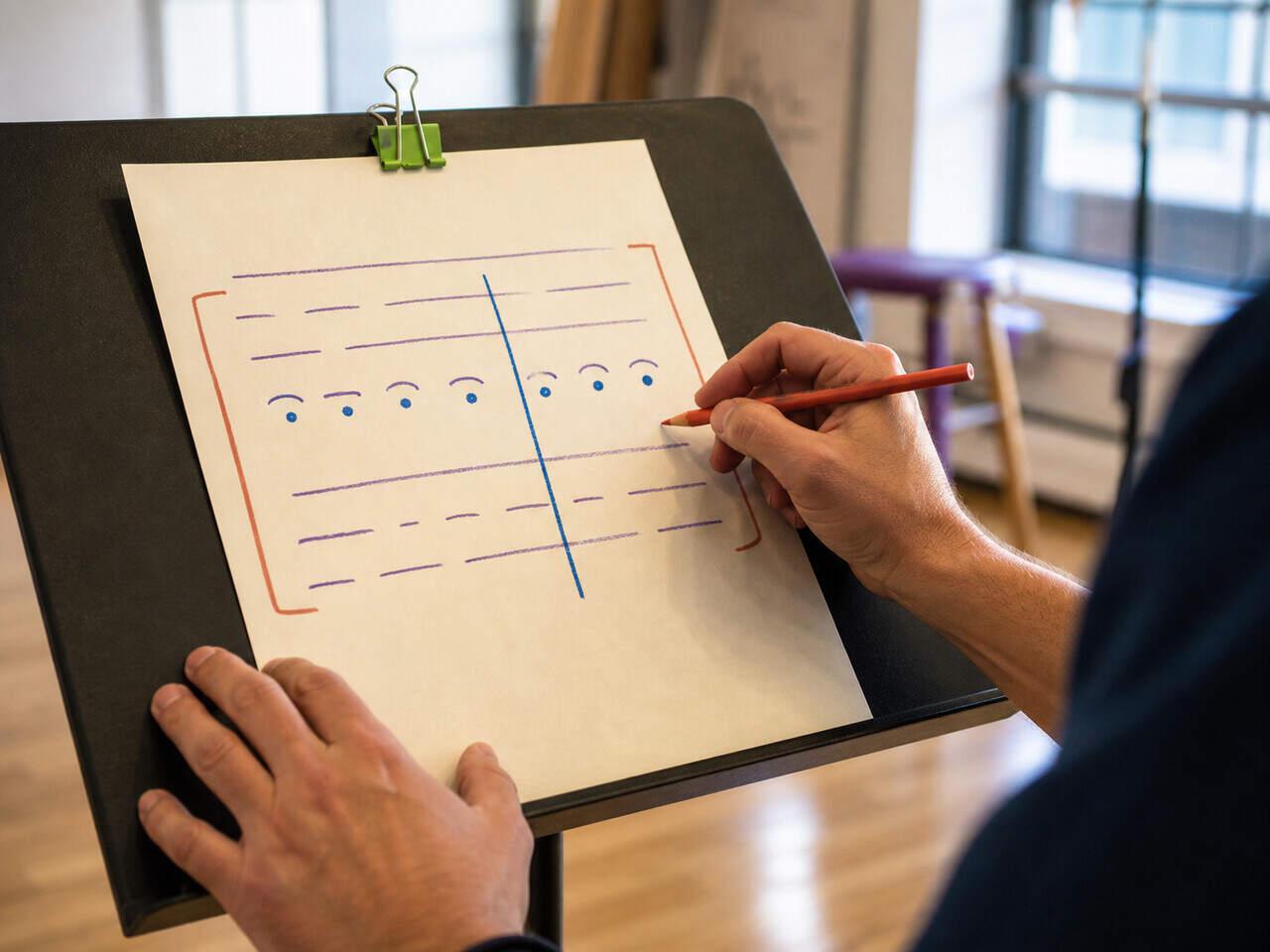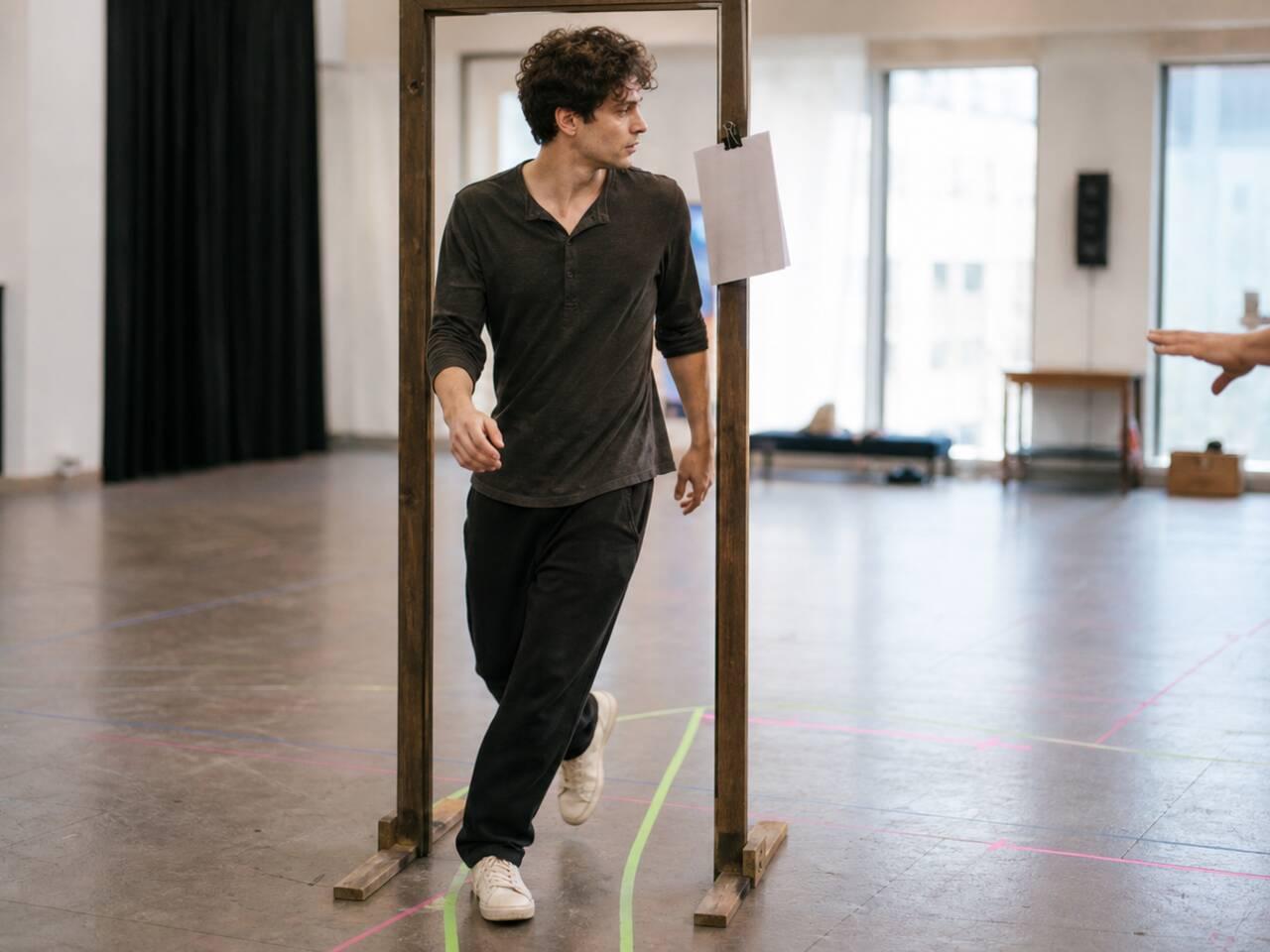
Actioning a script means giving every thought a transitive verb: something your character does to the other person, written as "I ___ you." I warn you. I corner you. I tease you.
The hard part isn't the method. It's choosing verbs you can play. First passes tend to fill up with verbs that describe a mood, a result, or plain information, and those rarely give you anything to do on your feet. Below: four tests for a playable verb, a worked pass on an original scene, and how to check your choices in rehearsal.
What Makes a Verb Playable: Four Tests
Run every verb in the margin through these four tests. They're working checks, not laws: a verb that fails one can still be right for you, but you should know why you're keeping it.
- It's transitive. It fits "I ___ you." "I'm frustrated" doesn't fit, because it's a state. "I scold you" fits.
- You play the attempt, not the outcome. Verbs like "convince" name the effect you're after, and plenty of actors use them well. The trap is playing as if it has already worked, or easing off when your partner holds out. If a verb pulls you toward the outcome, swap it for a neighbor that keeps you working, such as "I press you."
- It aims at a change you can watch for. If you warn someone, you're watching for them to back off. If the verb gives you nothing to watch, you'll end up playing to yourself.
- It changes something on numbers. Play the verb while you say only "one, two, three, four." Alone, check that it changes your body and voice, and that it feels different from the verb next to it. With a partner, ask what they felt you were doing to them. Then go back to the text and pursue the change you want, not the word.
Five kinds of verb often stall a line. The table shows when.
| Verb family | Example | When it stalls you | Possible swap |
|---|---|---|---|
| State or emotion | I'm angry, I'm hurt | Always: you can't do it to someone | I scold you, I wound you |
| Result | I convince you, I make you cry | When you start playing the outcome, not the attempt | I press you, I needle you |
| Information | I explain, I tell, I inform | When it would fit any line in the scene, so it changes nothing | I warn you, I correct you |
| Delivery note | sarcastic, quietly | Always: it's a line reading, not an action | I mock you, I soothe you |
| Thesaurus verb | I galvanize you | When you can't feel it as different from a plainer verb | Keep the verb you can feel |
The last row is the one nobody warns you about. With a verb dictionary open, it's tempting to pick the most interesting word. Interesting isn't the test. If "galvanize" and "rally" come out the same in your body, keep the one you understand physically.
How to Action a Script, Step by Step
Work in pencil, one scene at a time. Give a two-page scene a 30-minute timebox for the first pass.
- Write the scene objective at the top. Every verb serves it. If you haven't set one yet, start with objectives and tactics. In this pass, tactics change per beat and actions change per thought, so you'll usually have more actions than tactics.
- Slash the text into thoughts, not sentences. One sentence can hold two thoughts. Three short sentences can be one thought. Put a slash where the character's intention changes. If you've already marked beats, a beat will often hold more than one thought.
- Draft a verb for every thought. Write it in square brackets after the slash. Don't polish yet. A rough verb beats a gap.
- Run the four tests on each verb. Swap anything that stalls you.
- Read the verb column on its own. Skip the dialogue and read only the verbs, top to bottom. They should tell the story of the scene. If they don't, look at the verbs before you blame the text.
Here's a worked pass on an original scene. Nina needs her brother Owen to sign the papers that sell their late father's boat. Her objective: to get Owen to sign tonight.
| Line | First pass | Problem in this moment | Revised |
|---|---|---|---|
| NINA: The buyer's coming at nine. / | [inform] | Fits any line; doesn't use the deadline | [alert] |
| I need your signature tonight. | [convince] | Repeats the scene objective, so it gives Nina no specific move | [corner] |
| OWEN: You could have asked me last month. | |||
| NINA: I did ask. Three times. You stopped answering. | [frustrated] | A state, not something she does to Owen | [accuse] |
| OWEN: I was busy. | |||
| NINA: Busy. / | [sarcastic] | A delivery note | [mock] |
| Owen, it's sinking at the dock. Every week costs us. | [explain] | Information with no pressure on Owen | [jolt] |
| OWEN: Dad built half of it with his own hands. | |||
| NINA: And he'd hate watching it rot. | [make him feel guilty] | Names Owen's reaction, not Nina's move | [enlist] |
Read the revised column alone: alert, corner, accuse, mock, jolt, enlist. It has a shape. Nina pushes harder, then changes approach on the last line: she stops fighting Owen and recruits their father to her side. The first-pass column tells you nothing about how the scene moves.
Notice that "enlist" isn't the obvious choice for that line. "Shame" would pass the tests too. Picking the less obvious verb that still passes is where actioning starts giving you choices instead of just labels.
How to Test Your Actions in Rehearsal
Paper verbs are guesses. Rehearsal tells you which ones work.
- Run the numbers drill alone. Before rehearsal, play each verb on numbers instead of words, aimed at an empty chair. If two neighboring verbs feel the same in your body, merge them or replace one.
- Look again at runs of the same verb. If one verb covers more than three thoughts in a row, reread those lines. Either the character really is laying siege, or you've stopped reading the scene. When the director says "it's all one note," check the verb column first, then check whether you're still listening and changing pace.
- Translate notes into verbs. "Less pleading" from the director becomes a swap from [beg] to [bargain]. You change the action, not the volume. That's faster than guessing what the note means.
- Keep your verbs private. Your partner doesn't need to know you're "cornering" them. If they react unexpectedly, keep the verb and adjust how you do it.
The biggest failure mode is the frozen line reading. If the line and the verb set into a single unit while you learn the text, you end up able to say the line only one way. Your partner gives you something new in week four and you can't answer it. Two habits prevent this:
- Keep the verbs in pencil while you learn the lines. Action the scene early, and treat every verb as a draft until the room has tested it. If the whole scene starts to sound fixed, do one neutral run with no actions, then put the verbs back.
- When a line locks, run it with a neighbor verb. Swap [alert] for [warn] and play the line again. If you can play both, the verb is serving you. If the line comes out the same both times, you've memorized a reading.
Actioning is a rehearsal tool, not a performance checklist. By tech, you should be playing your objective and listening, with the verbs underneath as a safety net. The script analysis hub shows how actioning fits with beats, subtext, and character breakdown.
Do it in HitCue
- Character focus view: read your lines in scene order without the rest of the page, next to your verb column, and spot the stretch where the same action repeats before your director calls the scene one note.
- Blackout mode: hide each line, read its verb, then recall the text while you play it, so you check your recall without dropping the intention. If a line won't come, go back to the cue and the text first, and judge the verb separately in the next run with your partner.
- Scene notes: keep the scene's verb column on the scene itself, with the swaps you tried after each run, so week-two changes don't get lost in an old pencil pass.
Open your next scene, write the verb column in Scene notes, then run it in Blackout mode, playing each verb while you recall the line. → Download HitCue