A read-through rehearsal is the first time the whole cast says the play out loud, sitting around a table. Used well, it's the start of your off-book work — not a warm-up you forget by the next rehearsal. The fastest way to shorten memorizing later is to capture three things while you hear the play: your cues, the rhythm of each scene, and any cuts the director makes on the spot. This guide shows you how to turn one session into a head start.
Treat the Read-Through as Off-Book Phase Zero
You only hear the play fresh once. After the read-through, blocking, notes, and repetition reshape how every scene sounds in your head. The read-through is the one moment you take in the whole arc before it gets fragmented into rehearsed pieces.
That matters because cues live in what you hear, not in what you read. When you memorize alone from the page, you learn your lines in order. On stage you don't get the page — you get another actor's voice, and you have to come in on it. The read-through is the first place those triggers exist out loud.
So the operating rule is simple: at the read-through, capture cues, not lines. Don't try to start memorizing your own text. Track what comes right before you speak, how fast the exchange moves, and where the silences fall. That's the raw material an off-book plan is built on.
This sits at the front of the broader early rehearsal and table read workflow. Get it right and every later phase costs you less.
What to Capture During the Read-Through
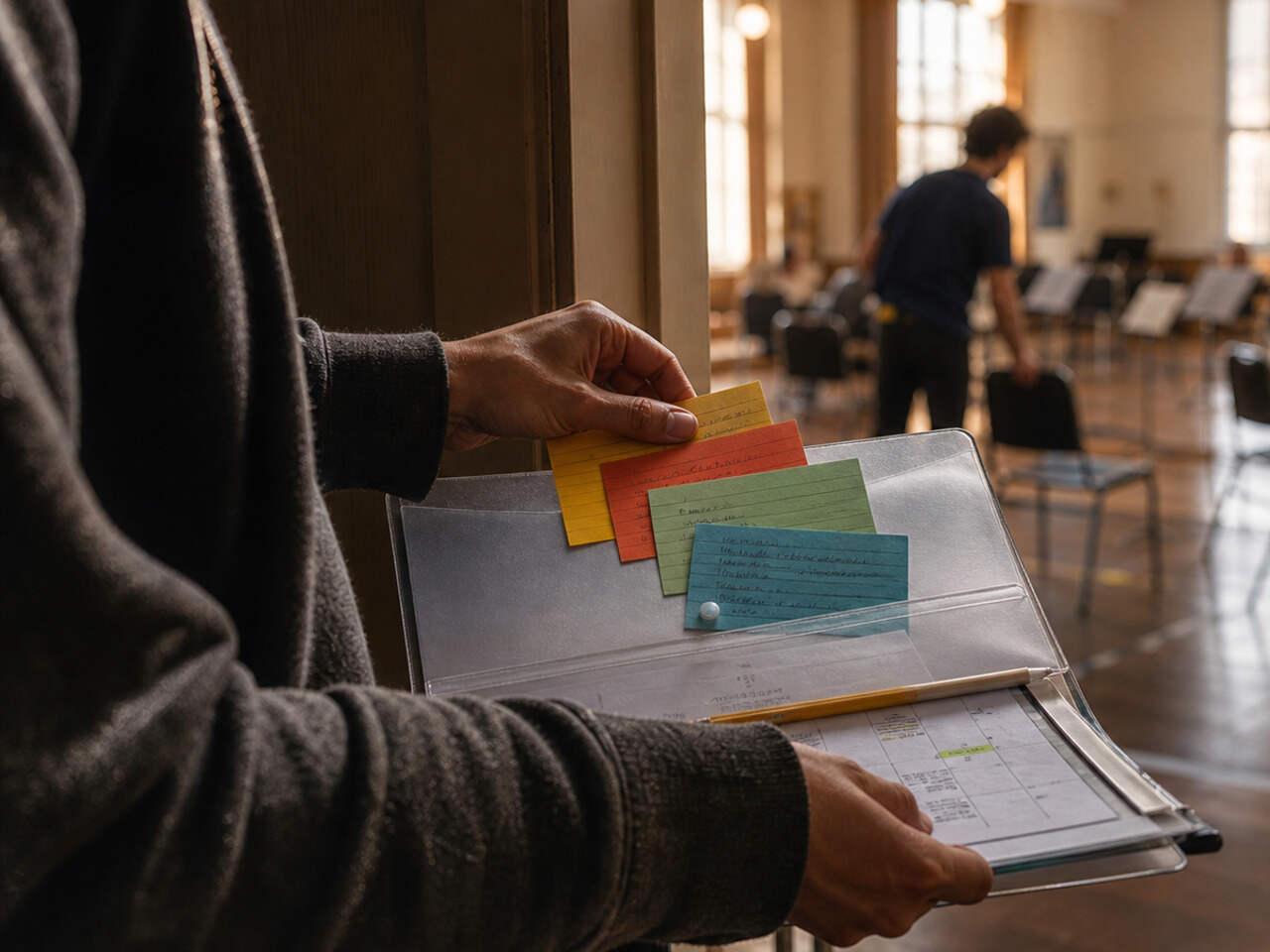
Keep one capture sheet — a notes column on your script, a shared doc, or a single page beside you. Write less than you think. You want signal, not a transcript.
Capture these four things:
- Your cue line. The exact words you hear before each of your entrances. Underline or note the last two or three words, not the whole speech.
- Scene rhythm. One word per exchange: overlap, pause, build, drop. This tells you which lines need timing, not just recall.
- Live changes. Any cut, added line, or reassigned line the director makes during the read. These are the notes people lose first.
- Confusing transitions. Spots where you weren't sure it was your turn. Those are exactly where you'll drop entrances later.
Here's a filled example from an original two-hander. Your character is Mara.
| Scene | Cue line (what you hear) | Rhythm | Change made today |
|---|---|---|---|
| 1.2 | Dev: "...then don't wait for me." | Fast overlap, no pause | — |
| 1.4 | Dev: "You knew before I did." | Long pause before you answer | Cut Mara's "I didn't, actually" |
| 2.1 | Dev: "...so that's it." | Build, then drop to silence | Added line: "Say it again." |
Notice scene 1.4. The director cut your reply on the spot, which means your new cue is now Dev's "You knew before I did" landing into silence — your next real line moved. If you only marked your lines, you'd memorize a cue that no longer exists and freeze when it doesn't come.
That's the most common failure mode here. People treat the read-through as a passive listen, then start memorizing from the original script a week later, off-book against cuts that changed in week one. Capturing live changes the day they happen is what prevents relearning.
Turn Your Read-Through Notes Into an Off-Book Plan
Capture is only half the value. The point is to convert it into an order of work before you memorize a single line.
Do this within 24 hours, while the read is still in your ear. Capture sheets go cold fast: a week later, "fast overlap" and "long pause" are just words, and you won't remember which transition tripped you up. Sit down the same night or the next morning, read your notes through once, and turn the shorthand into a plan while you can still hear the play in your head.
- Rank your scenes by load. Count your lines per scene and mark the cue-dense ones — fast overlaps, tight transitions. Heavy and tricky scenes get the most rehearsal time and the earliest start.
- Work backwards from blocking dates, not page count. A scene blocks before you can run it off-book usefully. Set your off-book target for each scene a few days ahead of when that scene gets staged, so you arrive ready to move, not still reading.
- Drill cues first. Use your captured cue lines to practice trigger-and-response before you worry about perfect recall of long speeches. Entrances are what get dropped under pressure.
- Re-check against changes. Before you lock any scene, confirm your cues still match the latest cuts. Read-through changes are the first wave; more will come.
Here's how that ranking looks with Mara's three scenes. Scene 2.1 carries the build-to-silence and a line added during the read, so it's the hardest to time and gets the earliest off-book date — pinned a few days before it's staged. Scene 1.2 is a fast overlap with few lines, so it ranks lower and starts later. Scene 1.4 holds the on-the-spot cut, so it goes straight onto the re-check list before you lock it. Three scenes, three different start dates, all decided before you memorize a word.
This is the bridge from table work into scheduling. Once you have scenes ranked and dates set, you're ready to build the calendar — the same logic behind a proper off-book rehearsal plan. The read-through gives you the data; the plan turns it into deadlines you can actually hit.
FAQ
Should I be off-book for the read-through?
No. Read-throughs are for hearing the play, not performing it. Coming in off-book this early usually means you memorized lines in isolation, before blocking and cuts settle, so you'll have to unlearn part of it. Read with the script open and spend the session capturing cues and changes instead.
What if the production skips the formal read-through?
Run a private one. Read the full play out loud once, ideally with a recording or a partner, before you start memorizing. You still need to hear your cues and each scene's rhythm at least once before they get buried under blocking notes and direction.
Do it in HitCue
- Scene notes: capture the cues, cuts, and rhythm you hear during the read-through, pinned to the exact scene where they belong.
- Character statistics: track your off-book progress per character as you work through the scenes you ranked from the read-through, so you can see which heavy ones still need time.
- Blackout mode: turn those captured cues into trigger-and-response tests once memorizing starts, one line at a time.
Import your script before the read-through, drop scene notes as you hear the play, then work down your off-book order and test each scene's cues in Blackout mode. → Download HitCue